
On this page
Quick answer: where should a bookshelf go?
In common Vastu practice, substantial book storage is often placed against a West, South-West or South wall. These zones are associated with stability and can also suit the real weight of a bookcase when the wall is dry and structurally sound. A reading or study seat is frequently arranged so the user faces East or North, provided the position has comfortable light, enough legroom and no distracting traffic behind the chair.
This is a planning preference, not a reason to force furniture into an unsafe corner. A bookshelf that blocks a door, covers ventilation, receives monsoon seepage or can tip onto a child is not improved merely because it occupies a preferred compass zone. First check direction correctly with the methods in our direction-checking guide; then balance tradition with safety and everyday use.
Best directions for bookshelves and home libraries
West and South-West
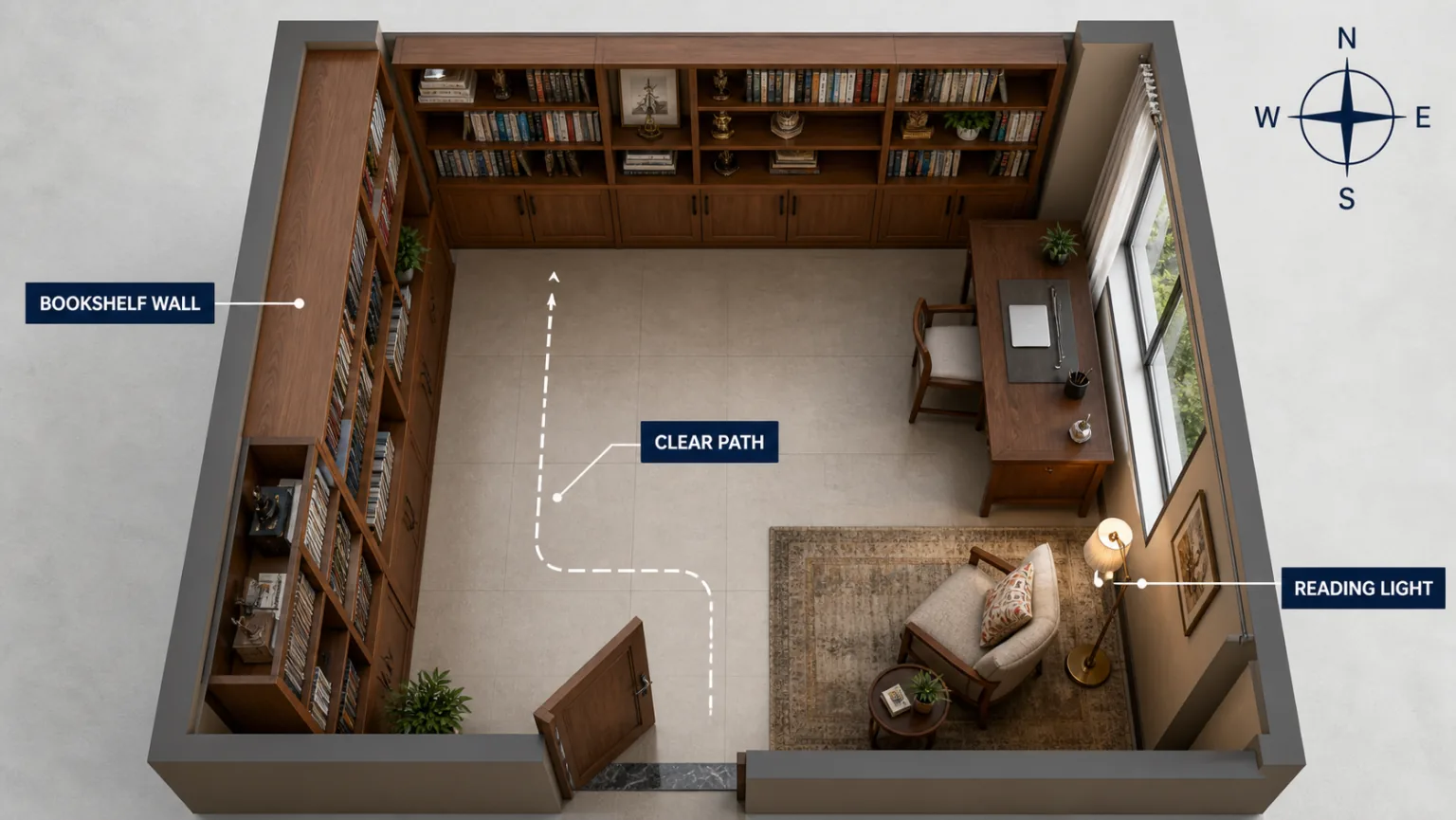
A West or South-West wall is a common first choice for a full-height library because heavier storage visually and physically anchors that side of a room. In a dedicated library, this may be the main book wall with lower closed cabinets for files and open shelves above. Leave enough clearance for doors to open fully and keep the central floor area free.
South-West also needs careful measurement. Do not squeeze a tall unit behind the study chair or into the swing of a bedroom door. If the only South-West wall has hidden plumbing or visible damp patches, use another dry wall rather than risking mould and damaged books.
South
A South wall can hold sturdy book storage, especially in a home office or multipurpose room. Protect books from harsh direct sunlight and heat. Dark timber can look premium in a large room, while cream, oak or light walnut usually feels less heavy in a compact flat.
North and East
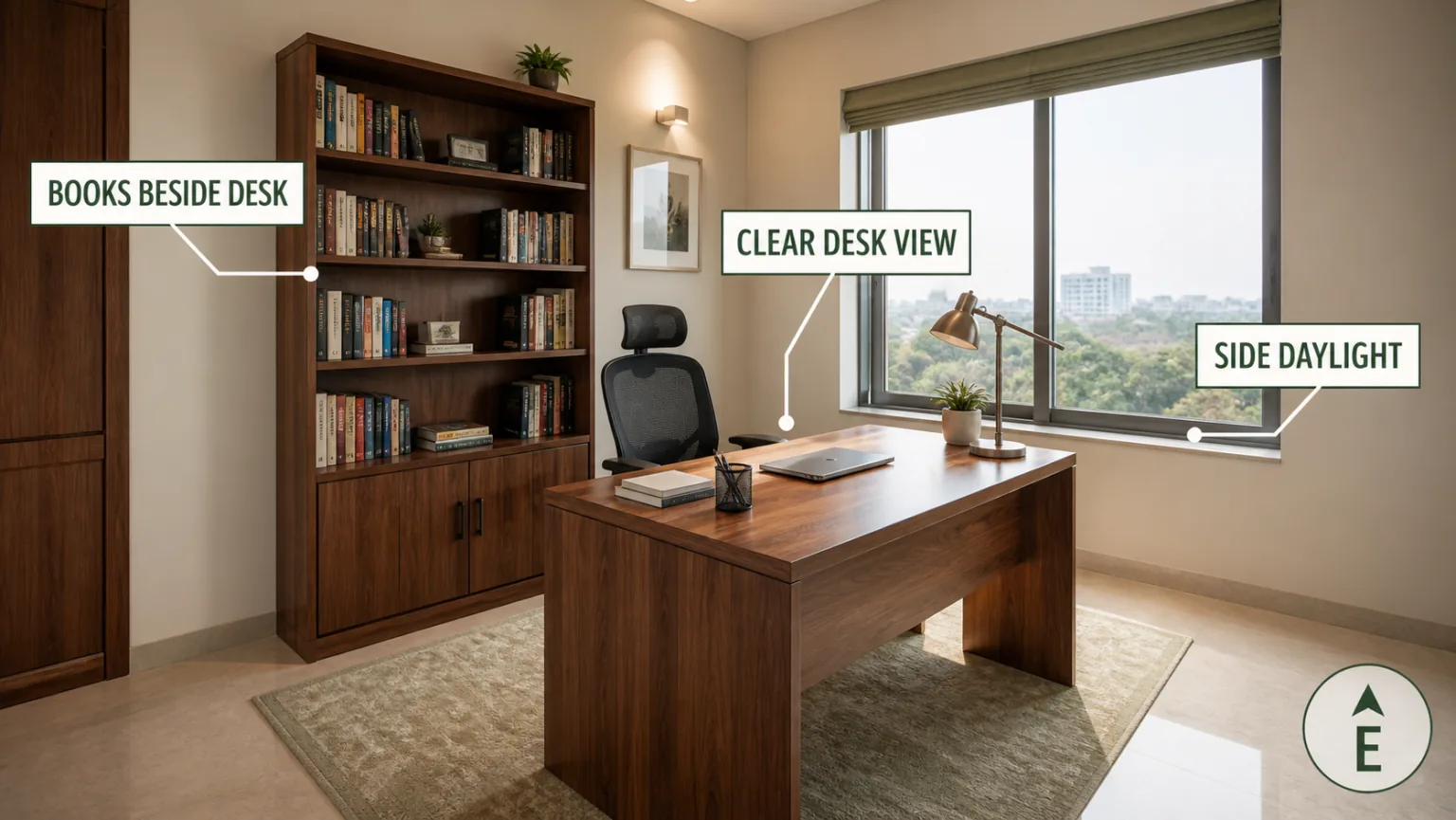
North and East are often valued for openness and study orientation. A low shelf, reading bench or compact reference unit may work here without blocking windows. Avoid building a tall, deep cabinet across the best daylight source. Soft side daylight is usually more useful than bright light falling directly onto a screen or book page.
North-East and the center
Many households prefer the North-East to remain visually light. Use a small open reading corner or a low shelf rather than dense floor-to-ceiling storage if the room permits. Keep the center of the room open for movement instead of using it for stacked cartons or a freestanding book tower.
Bookshelf Vastu by room
Dedicated home library
A separate library gives the most freedom. Begin with an inventory: textbooks, novels, office records, children’s books and sacred texts all need different depths and access heights. Put frequently used books between waist and eye level, heavy volumes lower down, and archival material inside labelled closed cabinets. A central table can work if circulation remains generous on all sides.
Use the wider principles in the complete home Vastu planning guide to relate the library to entrances, windows and adjacent rooms rather than treating one wall in isolation.
Study room
In a study room, books should be reachable without crowding the work surface. A shelf beside or slightly behind the desk is usually easier than a tall unit directly above the user. Arrange the chair so the student can sit upright and see the room entry without being in the doorway’s path. If East- or North-facing study is possible without glare, it can align with traditional preference.
Living room
A living-room bookshelf can be both useful and attractive. Choose one strong wall and avoid filling every visible surface. Closed lower cabinets hide cables, documents and board games; open upper shelves can hold books with a few carefully spaced objects. Check the Living Room Vastu guide before positioning the unit near seating, windows or the television.
Bedroom
Keep bedroom storage calm. A small shelf for current reading is preferable to office archives, exam piles and leaning towers near the bed. Do not mount heavy books directly above the headboard. If the bedroom doubles as a study, separate the work zone with a closed cabinet or finish the day by clearing the desk. See Bedroom Vastu and our wardrobe placement guide for coordinated storage planning.
Children’s room
Children need visible, easy-to-return storage. Use low shelves, wall anchoring, rounded corners and baskets with simple labels. Keep large encyclopaedias and school files on lower levels. Avoid glass doors in an active play path. The Children’s Room Vastu guide covers bed, study and storage relationships in more detail.
Home office
A home office benefits from separating active reference material from long-term records. Keep daily books close to the desk and move old tax files, packaging and obsolete manuals into labelled archive boxes. This prevents the bookshelf from becoming a visual reminder of unfinished work.
Bookshelf wall-direction planning table
| Wall or zone | Suitable use | Check before placement | Avoid |
|---|---|---|---|
| West | Main book wall or closed library unit | Wall strength, door swing and depth | Overcrowding a narrow passage |
| South-West | Heavy, stable storage | Dry wall and secure anchoring | Hidden plumbing or seepage |
| South | Office books and reference files | Heat and direct sun exposure | Dark finishes in a tiny room |
| North or East | Low shelf or reading corner | Natural light and window access | Blocking the brightest window |
| North-East | Light reading shelf | Visual openness and cleanliness | Dense floor-to-ceiling storage |
| Center | Open circulation | Comfortable movement | Book stacks or freestanding towers |
How to plan a useful library layout
- Confirm North: take several compass readings away from large metal objects, then mark directions on the floor plan.
- Measure the wall: record width, height, skirting, sockets, windows and door swing before selecting furniture.
- Map movement: preserve the route between the entrance, desk, chair, window and frequently used storage.
- Group books: place daily books within reach, heavy books low and valuable or sacred books in protected sections.
- Plan light: combine ambient room light with a focused reading lamp that does not create glare.
- Anchor and test: secure tall units, open every shutter and drawer, and confirm that nothing collides.
Open shelves, closed cabinets or mixed storage?
| Type | Advantages | Limitations | Best use |
|---|---|---|---|
| Open shelf | Easy access, lighter appearance | Collects dust and looks untidy quickly | Current reading and attractive books |
| Closed cabinet | Protects from dust and hides files | Needs door clearance and ventilation | Documents, archives and valuable books |
| Glass-front cabinet | Visible yet protected | Glare, fingerprints and child-safety concerns | Adult library away from play routes |
| Mixed unit | Combines display and concealed storage | Needs thoughtful organisation | Living rooms and compact apartments |
Bookshelf safety, weight and storage order
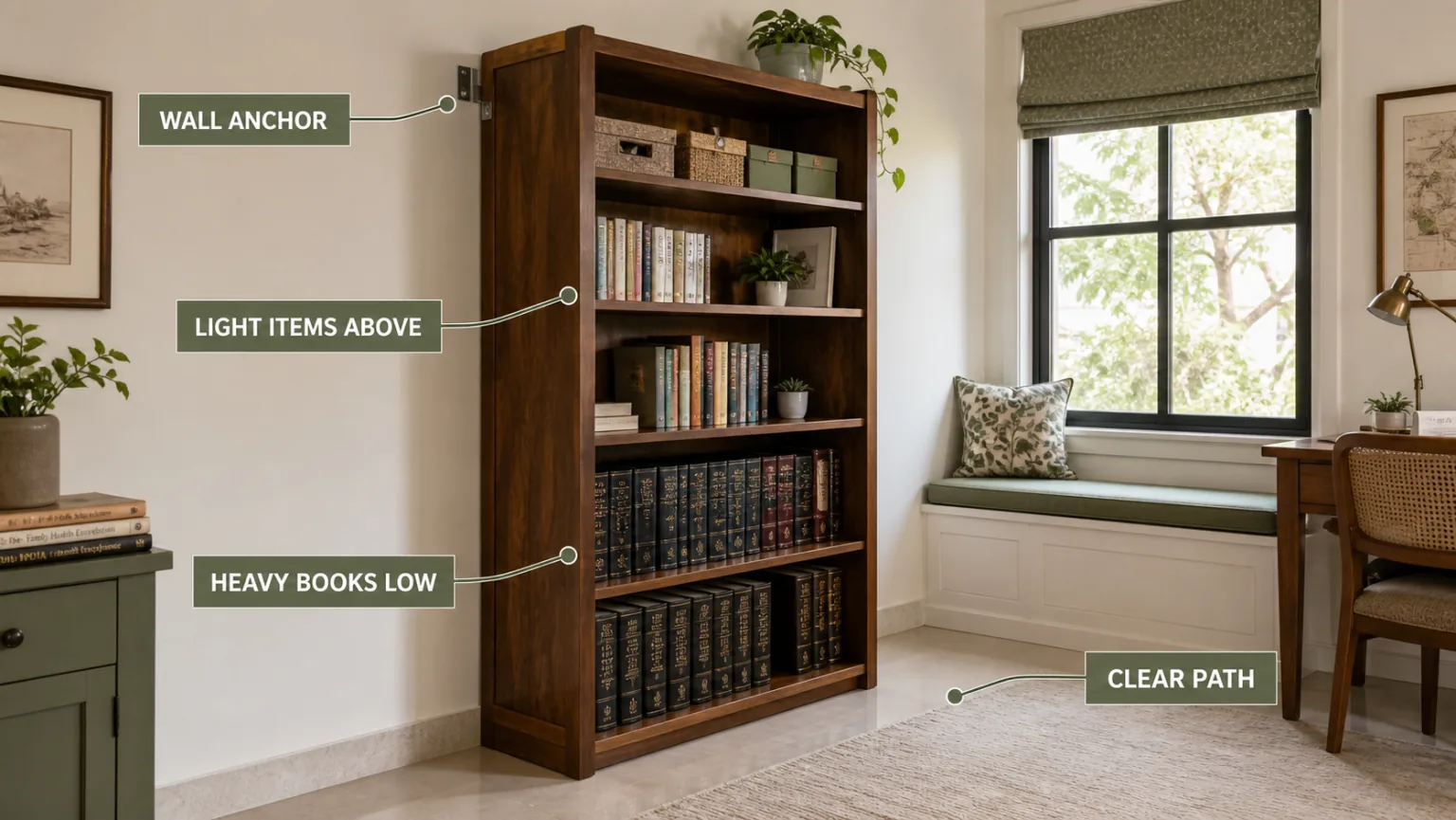
Books are unusually heavy for their size. Tall shelves should be fixed with appropriate anti-tip hardware suited to the wall material. A masonry wall, stud partition and hollow block may require different fasteners, so follow the furniture manufacturer’s guidance or use a qualified installer. Never rely on decorative balance alone.
Place the heaviest books and storage boxes on the lowest shelves. Keep lighter paperbacks and rarely used items above. Do not store stone objects, large planters or unstable décor on top. In earthquake-prone regions or homes with children, anchoring and low weight distribution deserve special attention.
Sunlight, ventilation and moisture control
Strong direct sun can fade covers and weaken paper over time. Use blinds, UV-filtering curtains or a side-facing shelf when a window receives harsh afternoon light. Do not press a closed cabinet tightly against a persistently humid wall; a small ventilation gap can help, but active seepage must be repaired first.
During humid Indian monsoons, inspect corners, shelf backs and rarely handled books. A musty smell is a warning, not something to conceal with incense or fragrance. Improve ventilation, dry the area and address the moisture source. Keep books away from bathroom plumbing walls, balcony splash zones and kitchen steam.
Books near a pooja room
Sacred books can have a clean, elevated section within a home library, or a dedicated closed shelf near the prayer area if space permits. Keep them away from oil lamps, incense smoke, water vessels and heat. The goal is respectful access without creating a fire or staining risk. Ordinary books can remain nearby when the whole area is orderly and the prayer route is not crowded.
Apartments and rental homes
Compact apartments often need one piece of furniture to serve several roles. A mixed bookshelf can divide a work corner, hold a printer and store family reading, but an open divider must not become top-heavy. When floor space is limited, a shallow wall-anchored unit is safer than a deep cabinet projecting into circulation.
Renters should ask before drilling. Landlord-approved anti-tip straps, a lower freestanding unit and careful weight distribution may offer practical alternatives. Use removable labels, closed boxes and a plug-in task lamp. These changes also fit the low-disruption approach explained in Vastu remedies without demolition.
15 common bookshelf Vastu and planning mistakes
1. Wrong direction reading
Placing furniture after one uncalibrated phone reading.
2. Blocking daylight
Covering the room’s best window with a tall cabinet.
3. Unanchored height
Using a tall, narrow shelf without anti-tip fixing.
4. Heavy books high
Putting dense volumes where they are difficult to lift safely.
5. Damp wall
Ignoring seepage, plumbing or monsoon moisture.
6. Door collision
Letting cabinet shutters conflict with room doors.
7. Crowded center
Using book piles as temporary furniture in circulation.
8. Bedside overload
Turning a restful bedroom into an archive room.
9. Desk clutter
Keeping every reference book on the work surface.
10. Unsafe glass
Using fragile doors in a child’s active route.
11. Harsh sunlight
Allowing direct sun to fade paper and bindings.
12. No categories
Mixing bills, schoolbooks and novels into one pile.
13. Decorative overload
Adding heavy planters and objects above books.
14. Poor lighting
Depending on one ceiling light for focused reading.
15. Ignoring real use
Choosing a stylish layout that nobody can maintain.
No-demolition fixes for an existing bookshelf
Start by removing everything and checking the wall, shelf joints and floor level. Return only useful books. Move heavy items down, group categories, add closed boxes for loose papers and leave some breathing space. A small warm task lamp can improve a dim corner without rewiring.
If direction is not ideal but the shelf is safe and practical, do not create disruption solely to chase a textbook position. Improve cleanliness, access, light and stability first. If moving the unit is easy, test another wall before committing. Compare how the new position affects doors, seating and daily movement.
For colour, use removable shelf liners, baskets or a lighter wall tone instead of replacing good furniture. Our Vastu colours for home guide can help you coordinate the library with the rest of the room.
Belief and practical planning: use both responsibly
Vastu guidance is a traditional planning framework. It should not be presented as a guaranteed method for academic success, wealth or health. A supportive library works because it makes books visible, protects them, reduces distractions and creates a repeatable reading habit. Direction can be part of the household’s cultural preference, while lighting, ergonomics, moisture control and safety provide measurable everyday benefits.
A balanced decision therefore asks two sets of questions: does the placement respect the family’s Vastu preference, and does it work safely in the actual building? When both answers are positive, the arrangement is more likely to remain useful over time.
Final bookshelf checklist
- North is verified on the floor plan.
- The selected wall is dry and structurally suitable.
- Tall units are anchored with correct hardware.
- Heavy books stay on lower shelves.
- Doors, windows, sockets and passages remain clear.
- Daylight does not cause strong glare or fading.
- Daily books are easy to reach.
- Children can use their shelves safely.
- Sacred books have a clean, protected section.
- The shelf can be dusted and maintained easily.
Frequently asked questions
Which direction is best for a bookshelf as per Vastu?
West, South-West and South walls are commonly preferred for substantial book storage. Choose a dry, structurally sound wall and keep the center and walking route open.
Can a bookshelf face East?
Yes. A bookshelf can face East when it fits the room safely. The more useful check is which wall supports the unit, whether daylight causes fading, and whether doors and passages remain clear.
Where should a study table face near a bookshelf?
Many Vastu traditions prefer a student facing East or North. Use that preference only when the chair remains comfortable, glare-free and away from a busy doorway.
Can books be kept in the bedroom?
Yes. Keep a small, organised collection rather than work files and unstable piles near the bed. Closed storage helps the bedroom remain restful.
Is a bookshelf suitable for the living room?
Yes. A living-room bookshelf works well on a stable wall when it does not narrow circulation, block windows or turn into crowded display storage.
Where should children’s books be stored?
Use low, wall-anchored shelves within easy reach. Keep heavy books at the bottom, round exposed corners and leave a clear path around the unit.
Which colours are good for a home library?
Warm white, cream, beige, soft green, muted blue and natural wood tones usually create a calm reading atmosphere. Room size and available daylight should guide the final shade.
Is an open or closed bookshelf better?
Open shelves provide easy access but collect more dust. Closed cabinets protect books and hide files. A mixed unit often suits Indian apartments best.
Can sacred books be kept with regular books?
They may be kept in a clean, elevated and clearly separated section. The practical priorities are respect, dry storage and protection from random clutter.
Should a bookshelf touch the ceiling?
It may, if professionally installed and ventilated. Tall units must be anchored to the wall, and items on high shelves should be light and rarely used.
How can renters improve bookshelf Vastu without renovation?
Reposition a freestanding shelf, use closed boxes, reduce clutter, add a task lamp and use landlord-approved anti-tip straps. Avoid drilling without permission.
Is a metal bookshelf acceptable?
Yes. Stability, finish and safe edges matter more than the material alone. Choose a powder-coated, rust-free unit that does not wobble.
How should books be protected from moisture?
Keep shelves away from leaking or damp walls, allow air movement, repair seepage and inspect books during humid months. Do not rely on fragrances to hide moisture.
What is the biggest bookshelf placement mistake?
An unanchored, overloaded shelf in a passage or children’s area is the most serious mistake because it combines poor circulation with a preventable safety risk.
Can a bookshelf be placed near a pooja room?
Yes, when the shelf remains clean and does not crowd the prayer area. Keep sacred books in a separate upper section and away from oil, incense smoke and heat.
Conclusion
Good bookshelf Vastu begins with accurate directions, but it succeeds through stability, order, useful light and safe access. West, South-West or South walls may suit substantial storage, while East- or North-facing study can be considered where the layout remains comfortable. Adapt these preferences to the actual apartment rather than forcing a risky arrangement.
Continue with the room-by-room Vastu overview or browse the VastuEssentials blog for practical planning guides.