
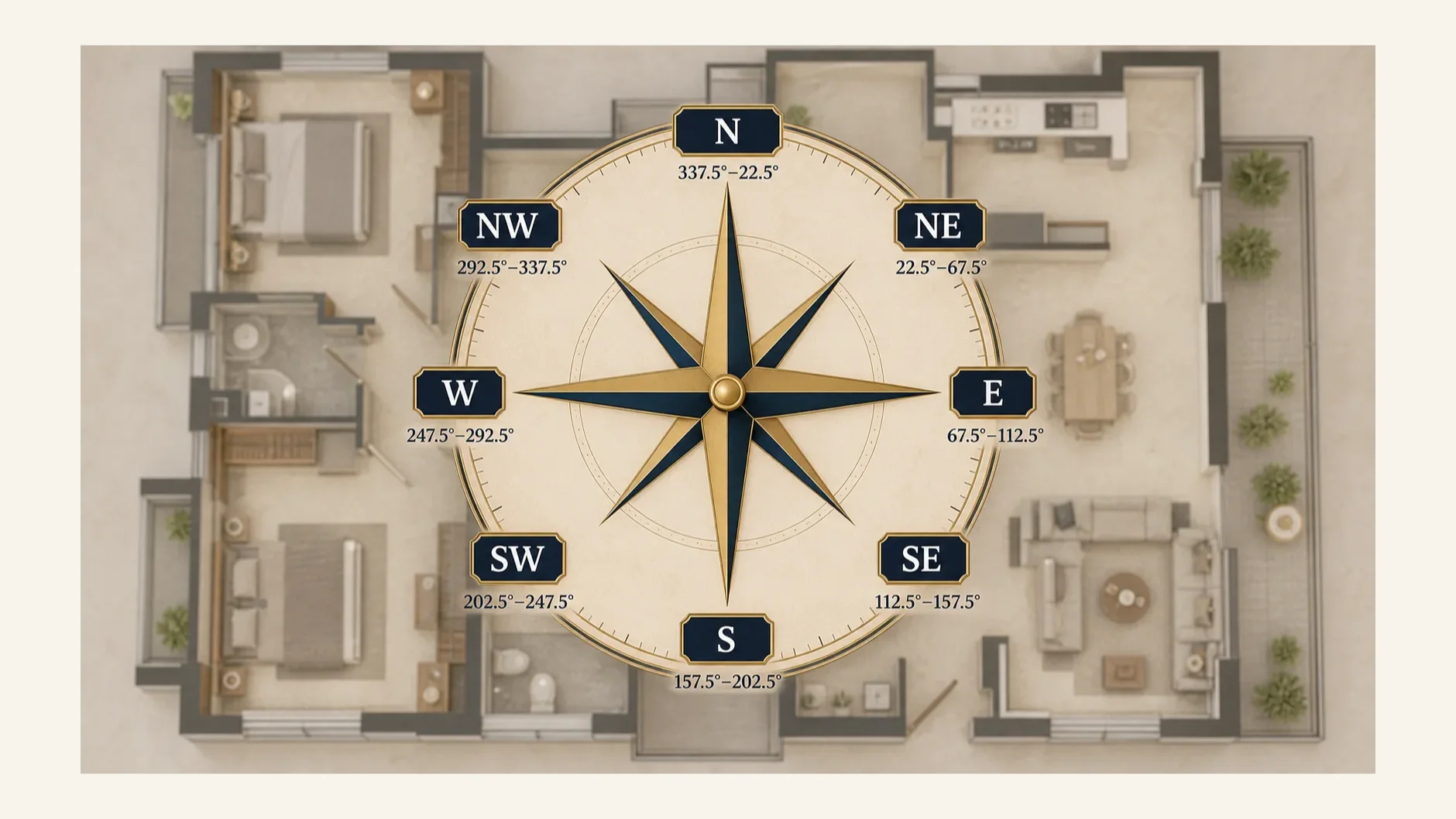
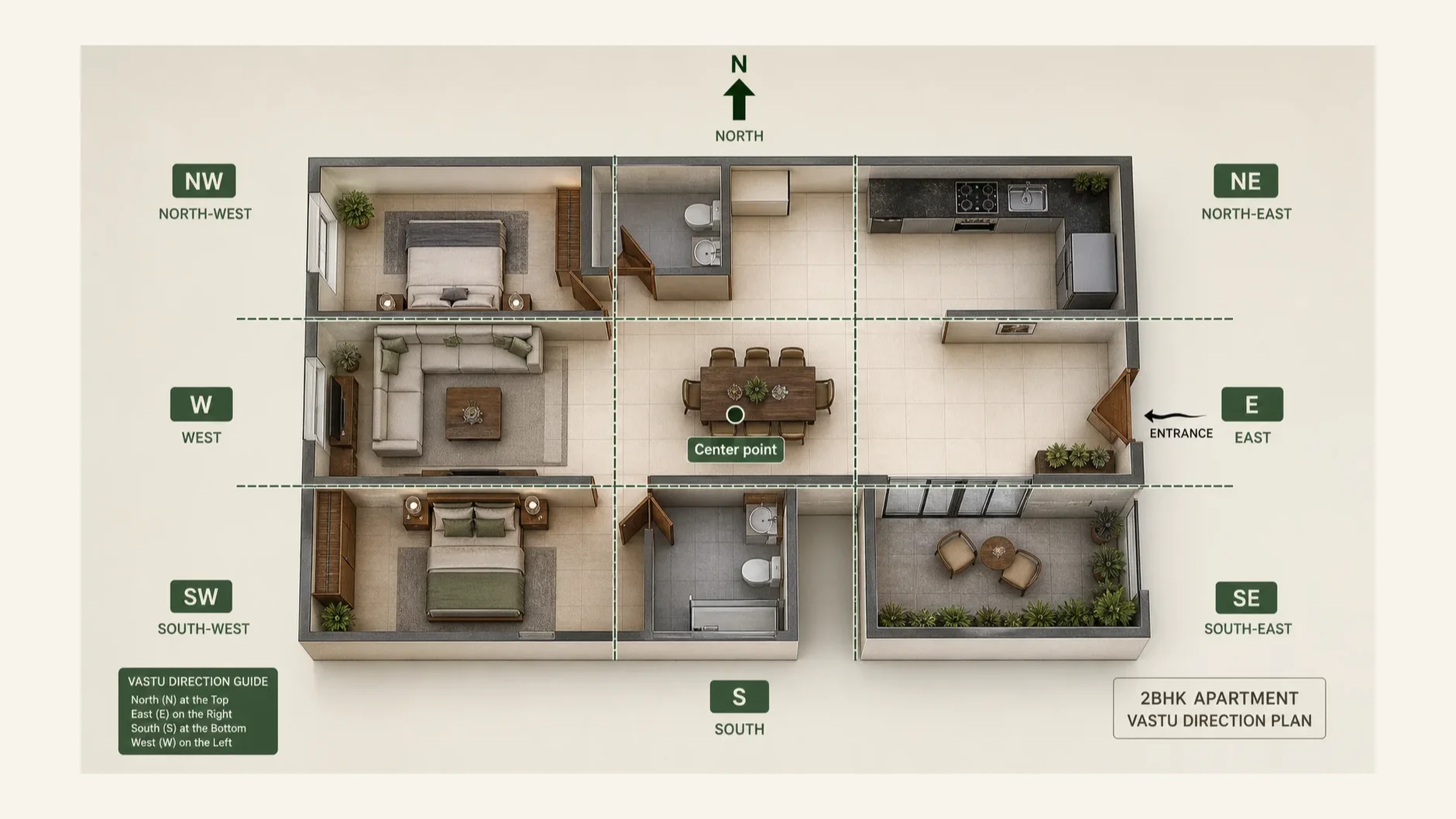
Why correct direction checking matters in Vastu
In Indian Vastu practice, many important rules are direction-based: main door zones, kitchen zones, bedroom stability (often South-West), pooja corner (often North-East), toilets kept away from the cleanest corner, and so on. But here’s the truth most buyers learn late: direction checking is where the biggest mistakes happen.
One broker says “east facing”, the building brochure says “north-east entry”, the phone compass shows “north” somewhere else, and suddenly you don’t know what is real. That confusion leads to wrong decisions—sometimes costly ones (buying the wrong unit, rejecting a good property, or planning room layouts incorrectly).
Facing direction vs entrance direction vs plot direction (don’t mix these)
Many beginners mix these three and end up with wrong conclusions. Let’s make them crystal clear:
1) Plot direction (for sites/plots)
Plot direction is usually defined by the road side / main gate side. If the road is on the east, the plot is commonly called east-facing. This is important for Plot & Land Vastu decisions and for gate/compound planning.
2) House facing direction (built structure)
House facing is typically the direction you face when you stand inside and look out through the main entrance. Some people define it by the side that has the main entrance approach. Always write down your definition before discussing it.
3) Entrance direction (main door zone)
Entrance direction is not only “east or west”. It includes the exact door position along the wall (NE/E/SE style zones). This is why a “north-facing” flat can still have a not-ideal entry if the door sits in an awkward zone. See Entrance & Main Door Vastu.
Quick rule for beginners
When you talk to anyone (broker, architect, family), ask: “Are we talking about plot facing, house facing, or entrance zone?” Write it down. This single question removes 70% of confusion.
Methods to check directions correctly (step-by-step)
Below are the most reliable methods. Each has strengths and weaknesses. The goal is not to find a “perfect” method; the goal is to get a direction result that is stable and repeatable.
Method 1: Smartphone compass (Android & iPhone)
Phone compass is the most common tool in India today—but it’s also the most misunderstood. Your phone compass uses a magnetometer sensor, which can be affected by: steel in buildings, elevators, electrical panels, car parking structures, phone cases with magnets, and even nearby metal objects (like keys).
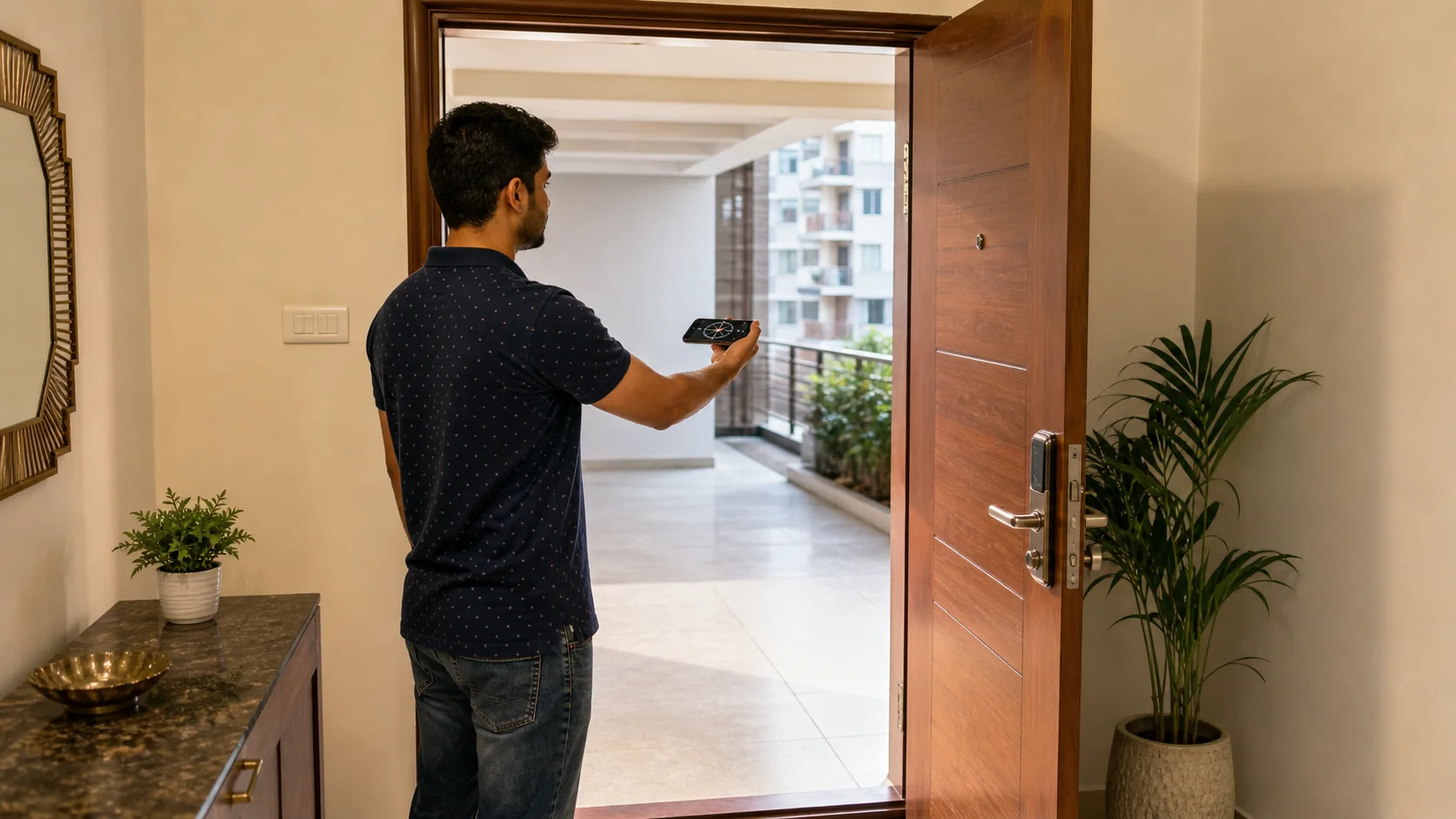
Step-by-step: phone compass
- Go to an open area away from large metal objects (balcony edge, open terrace, near a window, or outside the building).
- Remove magnetic case or keep distance from your smartwatch/earbuds case.
- Calibrate the compass (see tips below) and wait 5–10 seconds for the reading to stabilize.
- Hold the phone flat (screen facing up). Slowly rotate your body, not the phone, and note north.
- Repeat from a second location. If results differ a lot, don’t trust it—use building plan or Google Maps.
Avoid this mistake
Don’t check directions right next to the main door frame in apartments—many frames have metal and many corridors have wiring, lifts, and pipes. Phone compass becomes unreliable in these spots.
If the phone compass is your only tool, do your reading near a window/balcony and then map the room corners using the plan.
Phone compass calibration tips (India-focused)
Android calibration
Most Android phones show a “figure 8” motion for calibration. Do it slowly, away from metal. Turn on location accuracy (high accuracy) and keep the phone away from chargers and power banks while checking.
If the compass still jumps, rely more on Google Maps orientation or the building plan.
iPhone calibration
iPhone compass can also drift near metal or inside towers. Turn on location services and keep the phone level. If you see unstable readings in a flat corridor, move to the balcony/window side and retest.
Tip: use Apple Maps/Google Maps to cross-check direction—don’t depend on one app only.
Method 2: Google Maps satellite view (best for plots and buildings)
Google Maps satellite view is underrated for Vastu direction checking. It is often more stable than phone compass inside high-rise buildings because it does not rely on your phone’s magnetometer. Instead, it uses map north orientation.
Step-by-step: Google Maps
- Open Google Maps and switch to Satellite view.
- Turn off “compass rotation” so north stays up (default is north-up).
- Locate the building/plot and identify the road side and approach.
- Use the map to label north, east, south, west around the property.
- Cross-check with the building plan if available.
Limitations
Satellite images can be outdated in fast-developing areas. In new layouts, roads may change. Use it as a strong clue, then verify on site. Also, for apartments, satellite view tells you building orientation, but you still need the flat’s entrance location from the floor plan.
Method 3: Traditional magnetic compass (simple and surprisingly reliable)
A basic magnetic compass is still one of the most reliable tools—especially outdoors. It’s inexpensive and doesn’t depend on phone sensors. But it still has one weakness: if you stand near metal or electrical sources, the needle can deviate.
Step-by-step: magnetic compass
- Stand in an open space away from vehicles, grills, gates, and large metal railings.
- Hold the compass flat and wait for the needle to settle.
- Align the needle to “N” marking and note the direction of the road/entrance.
- Repeat at two points (front and back) to confirm stability.
Best use cases
Plots and independent houses. Also useful in open terraces of apartments. Combine it with a building plan for exact entrance zone work.
For indoor checks in a tower, the compass needle can drift near elevators and concrete steel reinforcement.
Method 4: Building plan / architectural floor plan (often the most accurate)
If you have a floor plan with a north arrow (or a site plan with north marking), it can be more accurate than a phone compass in modern buildings. This is especially true in Indian apartments where steel and electrical systems can distort compass readings.
Step-by-step: using a plan
- Find the north arrow (or ask the architect to confirm north reference).
- Mark the main door location on the plan.
- Draw a simple compass grid over the plan (or use our visuals).
- Identify the NE/SE/SW/NW corners and label them.
- Now apply room rules: kitchen SE, pooja NE, master SW, toilets away from NE (common guidance).
Where beginners go wrong
They assume the top of the plan is north. Sometimes it is. Sometimes it is not. Many plans are rotated for paper fitting. Never assume north—always verify with the north arrow or architect’s note.
If you want visual examples, open Balanced Layout and compare with your plan.
Method 5: Sunlight and shadow observation (helpful cross-check)
Sun observation is a traditional cross-check method that still works if you do it correctly. In India, morning sun rises roughly in the east (with seasonal variation), and evening sun sets roughly in the west. This method is not for precise degree measurement, but it can help detect when a broker is clearly wrong.
Step-by-step: sun check
- Visit the property in the morning (8–10 AM) and note which side receives direct light.
- Visit again late afternoon (4–6 PM) and observe the opposite side’s light/heat.
- Use this only to cross-check your compass/plan result, not to replace it.
Warning
High-rises and nearby buildings can block sunlight. Trees and shadows can confuse you. Use sun check only as a supporting clue. For exact direction checking, rely on plan + compass/mapping.
Direction checking by property type (India-focused)
Apartments / flats
In flats, the biggest confusion is: “Is the flat facing direction decided by balcony side or main door?” Different people define it differently. For Vastu planning, it’s usually more helpful to identify:
- Main door direction/zone (entrance)
- Kitchen zone (often SE)
- Bedroom zones (often SW stability)
- NE corner (keep light/clean)
Best method: use the floor plan with north arrow. Use phone compass only as a cross-check near window/balcony (not in corridor).
Independent houses
Houses allow more reliable compass checking outdoors. Do your compass reading at the gate/entrance and also in the backyard to confirm stability. Then map the house plan with the same north reference. For house planning, use Home Vastu.
Plots / sites
Plots are usually the easiest: road side decides plot facing. But still, mistakes happen because roads can be diagonal or the plot can be corner/irregular. Use Google Maps satellite view and then confirm on site with a magnetic compass. For plot planning, see Plot & Land Vastu.
Duplex homes
In duplexes, direction checking is similar to houses, but the big practical issue is staircase placement and flow. Measure directions at ground floor and confirm that the staircase location is not confusing the “center” circulation. For visual planning, compare with Balanced Layout.
Commercial offices and shops
Commercial spaces should prioritize customer flow, safety, and hygiene. Direction checking matters, but your “Vastu result” improves most when you: keep entry/reception clean, keep toilets odor-free, and keep storage disciplined. For a full office page, see Office Vastu.
Comparison table: Phone Compass vs Building Plan vs Traditional Compass
| Method | Best for | Strength | Weakness |
|---|---|---|---|
| Phone compass | Quick checks, outdoor cross-check | Fast and convenient | Unreliable near metal / lifts / wiring |
| Building plan | Flats, towers, accurate zone mapping | Stable if north arrow is correct | Plan may be rotated; needs correct north marking |
| Magnetic compass | Plots, houses, terraces | Simple, no phone sensor issues | Can deviate near metal / vehicles |
| Google Maps | Plot and building orientation | Stable north reference | Satellite image may be outdated; doesn’t show flat door zone |
Common mistakes while checking house directions
Mistake 1: checking inside lift lobby
Lift shafts and steel reinforcement can distort phone compass. Check near balcony/window instead.
Mistake 2: assuming top of plan is north
Plans can be rotated. Use the north arrow or ask the architect/builder.
Mistake 3: mixing “facing” definitions
Write down whether you mean plot facing, house facing, or entrance zone.
Mistake 4: trusting a single reading
Use two methods (plan + compass/maps). Repeat readings from two points.
Myths and misconceptions about Vastu directions
Myth: “If it’s not east-facing, it’s bad”
Reality: comfort depends on layout, ventilation, and maintenance. Facing is one input. Use Home Vastu to prioritize room placement and daily flow.
Myth: “Phone compass is always correct”
Reality: phone compass can be wrong inside towers. Cross-check with plan or Google Maps. If readings jump, don’t force a conclusion.
How builders and brokers sometimes show incorrect directions
This is common in India: “north-facing premium” becomes a marketing term. Sometimes it’s an honest mistake (wrong definition). Sometimes it’s intentional. The safest approach is to verify directions before paying token/booking amount. You can also use the House Direction Finder after taking a stable compass reading.
Checklist: verify directions before buying property
For flats
- Get the floor plan with north arrow
- Mark main door zone and kitchen zone
- Cross-check building orientation on Google Maps
- Do a phone compass check near balcony/window only
For plots
- Confirm road side and gate side
- Check shape, slope, and drainage
- Use satellite view and an on-site compass cross-check
- Read Plot & Land Vastu before final decision
Recommended next reads
Home planning
Plot & entrance
FAQ (direction checking)
How do I check house direction correctly for Vastu?
Use two methods: (1) a building/floor plan with a north arrow, and (2) a compass method (phone compass near balcony/window or a magnetic compass outdoors). Confirm both match closely. Then label corners (NE/SE/SW/NW) on the plan and apply Vastu rules.
Is phone compass accurate for Vastu?
Sometimes. It can be inaccurate inside apartments due to steel and electrical interference. Use it as a cross-check only. If readings jump or differ by a lot between two locations, trust the building plan and Google Maps more.
Which direction should a house face in Vastu?
Many Indian traditions like north/east facing, but facing alone doesn’t decide quality. Room placement, ventilation, drainage, and daily flow often matter more. A well-planned home can work in many facings. See Home Vastu for priorities.
How do I check a flat’s entrance direction?
Use the floor plan (with north arrow). Mark the main door position, then see which direction the door opens toward and which zone it falls into (NE/E/SE, etc.). Avoid relying on corridor compass readings. For details, see Entrance & Main Door Vastu.
How do I identify the North-East (NE) corner correctly?
First establish north using a plan or compass. Then NE is the corner between north and east. On your plan, draw a simple north/east axis and label the corner. Use our direction grid as a reference in Balanced Layout.
Why does my compass show different directions in different rooms?
Indoor compass variation is common due to metal, wiring, and reinforced concrete. That’s why the building plan (north arrow) is often more reliable for flats. If you must use phone compass, check near windows/balcony and calibrate properly.
What are the most common direction checking mistakes?
Checking near lift lobby, assuming top of plan is north, mixing plot facing and entrance direction, and trusting a single reading. Use two methods and write down your definition of “facing” before deciding.
Can I use Google Maps to check directions for Vastu?
Yes—Google Maps satellite view is excellent for plot and building orientation. It helps confirm road side and gate side. For flats, it won’t show the flat’s exact door zone, so combine it with the floor plan.
More Vastu guides to read next
Home and layout
Home Vastu, Apartment Vastu, Balanced Layout, Small Apartment Vastu
Directions and buying
Check Directions, Main Door Vastu, East-Facing House, North-Facing House
Room-wise help
Kitchen Vastu, Bedroom Vastu, Bathroom Vastu, Pooja Room Vastu
Focus and work
Study Room Vastu, Home Office Vastu, Wealth Vastu, Office Vastu
Remedies and support
Vastu Remedies, No-Demolition Remedies, Vastu FAQ, Trust and Support
Popular blog topics
Kitchen Do's and Don'ts, Mirror Vastu, Vastu Plants, Brahmasthan Vastu
Conclusion
Direction checking is the foundation of Vastu. If you measure direction incorrectly, every “dosha” and every “remedy” becomes guesswork, including advice in Vastu Remedies. The premium, low-stress way is simple: use two methods (plan + compass/maps), repeat readings, write down what you mean by “facing”, and then apply room rules with confidence.
If you want to go deeper, start with Home Vastu, review the plan examples in Balanced Layout, and then apply room-by-room checklists from Room-wise Vastu.