
On this page
- Quick answer
- Why AC placement matters
- Best direction according to Vastu
- Best wall for AC placement
- Bedroom AC placement
- Living room AC placement
- Split AC vs window AC
- Indoor unit placement
- Outdoor AC unit placement
- AC drainage and condensate
- Placement by room direction
- AC placement in apartments
- If the AC point is fixed
- Common mistakes
- Installation checklist
- Vastu belief vs HVAC guidance
- Frequently asked questions
Quick answer: where should an AC be placed?
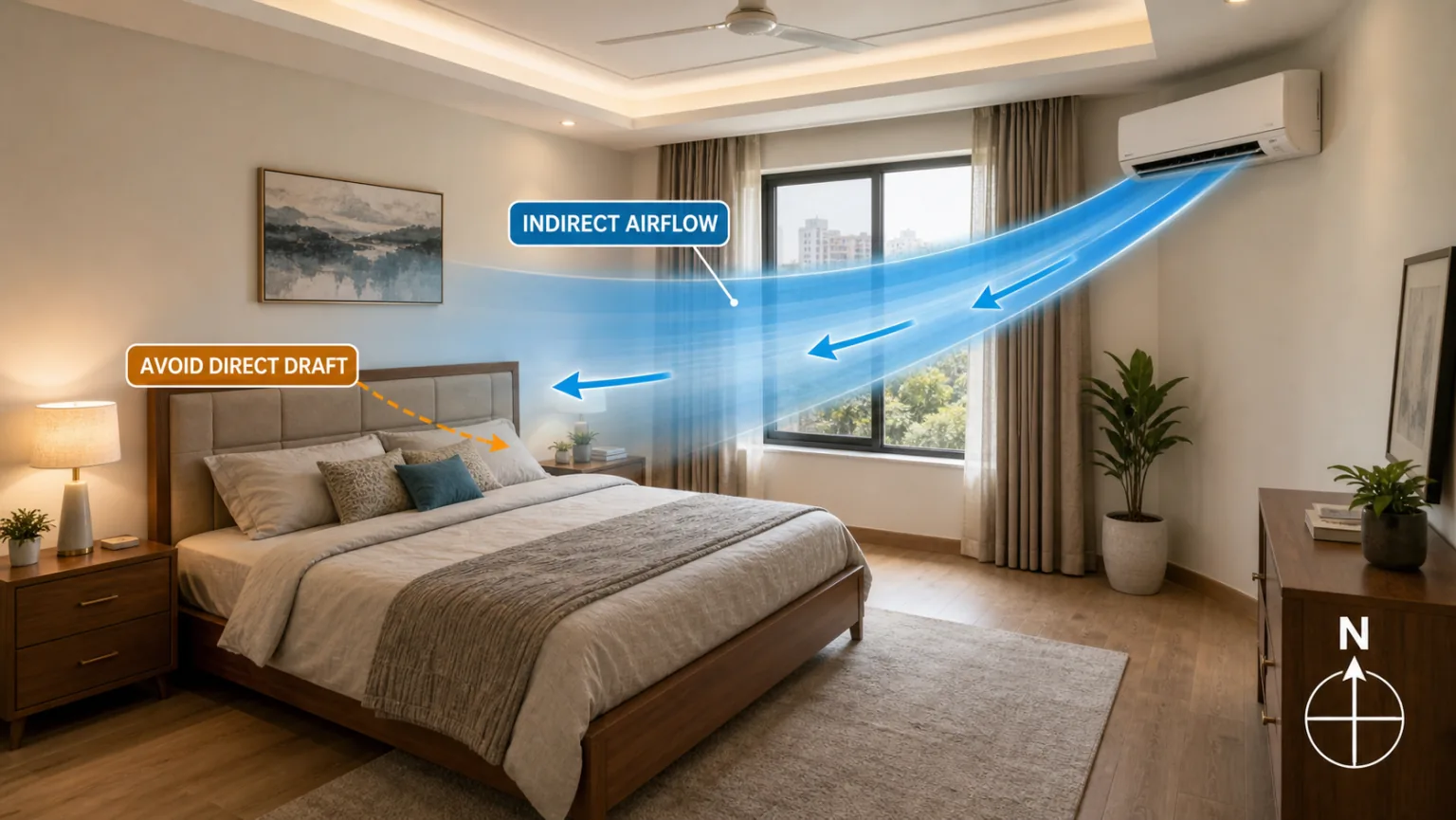
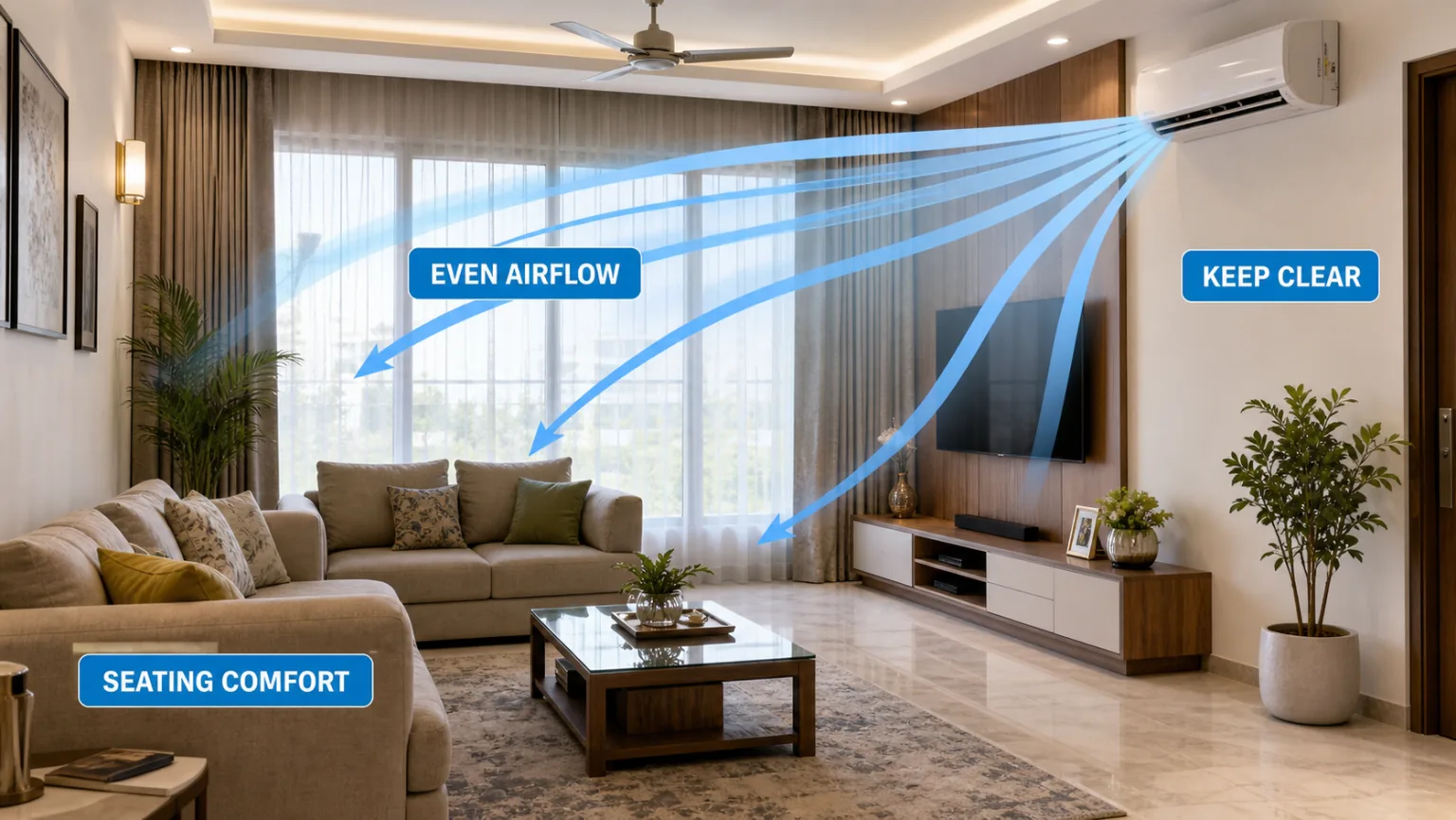
Traditional preference: Southeast and Northwest are commonly suggested. Bedroom: use a side wall so air crosses the room instead of the pillows. Living room: cool evenly without aiming a constant draft at the sofa. Priority: structural safety, manufacturer instructions, electrical protection, drainage, outdoor ventilation and professional installation come first.
Why AC placement matters in Vastu and comfort
In modern Indian homes, air conditioners support everyday comfort in hot cities, humid coastal areas, high-rises and compact bedrooms. AC placement affects airflow, sleep, wiring, drainage, wall use and maintenance—not direction alone.
Traditional Vastu considers direction and natural movement; an AC adds artificial airflow, sound, cooling and heat exchange. A unit that blows on the face or leaks into a wall is uncomfortable even when its compass zone appears ideal.
Start with the bed, sofa, windows, electrical point, drain and outdoor unit. Choose even cooling without disturbing sleep or seating. If orientation is uncertain, follow How to Check Directions Correctly before applying directional advice.
An AC cannot correct poor insulation or unsuitable equipment size. Let a qualified HVAC professional assess heat load and installation, then coordinate the result with the Complete Home Vastu Planning Guide.
Best direction for AC according to Vastu
Vastu traditions vary, but Southeast and Northwest are often suggested for cooling equipment. Do not force a unit onto an unsuitable wall: the AC zone, mounting wall and airflow direction are three separate decisions.
Southeast zone
Southeast is associated with the fire element and electrical appliances. Use it only when the unit stays clear of curtains, drains safely and sends air past—not directly at—the bed or sofa.
Northwest zone
Northwest is associated with movement and air. It can work when cooling spreads through open space, but first check windows, wardrobes, beams and balcony doors.
Other practical placements
Any wall direction can be practical when it is strong, drains correctly and supports comfortable airflow. If Southeast or Northwest is unavailable, improve the existing point. No direction guarantees health, wealth or success.
Best wall for AC placement
The best wall is strong, near a safe electrical point, compatible with the approved pipe and drain route, and open enough for air to spread. Check concealed wiring, plumbing and beams before drilling.
Airflow
Choose a wall that lets air cross open space. Avoid curtains, pelmets, wardrobes, tall cabinets and decorative screens that obstruct the outlet or air return.
Drainage
Plan a continuous condensate route that does not pass above sensitive furniture or electrical equipment and does not stain the façade or a neighbour’s area.
Service access
Filters, covers and connections need to remain reachable. A beautiful concealed installation becomes expensive when routine cleaning requires dismantling joinery.
Windows affect heat load, and curtains can block a poorly positioned unit. Review the Window Placement Vastu guide, then let the technician assess cooling needs.
Bedroom AC placement Vastu
A bedroom needs gentle, even cooling and low noise. Coordinate AC position with the guidance in Bedroom Vastu and Master Bedroom Vastu, but judge the final choice by how the air feels at pillow height.
AC above the bed
Avoid the headboard wall when another safe option exists. Draft, noise, condensation risk and cleaning above the bed can be inconvenient. With a fixed point, adjust louvers and move the pillows away from the strongest air path.
AC opposite or beside the bed
An AC opposite the bed can work when air travels above or toward the foot-side. A side wall often gives better control. Test the airflow from pillow height before drilling.
Small-bedroom limitations
In a compact room, keep the outlet clear, preserve filter access and avoid squeezing the unit above a wardrobe. Do not move the bed where it blocks a door. Split systems are flexible, but piping and drainage still limit placement.
Example: With a south headboard and west wardrobe, an east or north wall may send air across the room. If the point is fixed above the bed, use indirect airflow and a small bed adjustment.
Living room AC placement Vastu
Living rooms have changing occupancy and may open into dining areas. Cool the main zone without creating one permanently cold sofa seat. Compare furniture placement with the Living Room Vastu guide.
Do not hide the unit behind curtains or cabinets. Avoid mounting above heat-producing electronics when possible. A side wall works when airflow reaches the seating area without hitting faces directly.
Large, open-plan or L-shaped rooms need a professional heat-load and airflow check. Better distribution—or more than one correctly sized unit—can matter more than visual symmetry.
Split AC vs window AC vs portable AC
| AC type | Placement flexibility | Airflow considerations | Maintenance considerations | Best use |
|---|---|---|---|---|
| Split AC | High for the indoor unit, but limited by piping, drainage and condenser location | Can distribute air widely when mounted on an open wall | Indoor filters and outdoor condenser both need service access | Bedrooms, living rooms and apartments |
| Window AC | Limited to a suitable exterior wall or window opening | Shorter, more direct air throw; avoid aiming it at the bed or sofa | Front and exterior portions must remain accessible | Compact rooms with an approved opening |
| Portable AC | Movable within reach of an exhaust window and safe power point | Keep intake and outlet clear; do not kink the exhaust hose | Condensate handling and filter cleaning vary by model | Rentals or temporary cooling where fixed installation is restricted |
A window AC is not automatically better or worse for Vastu. Its location is governed by the available exterior opening. A split AC provides more freedom to avoid direct draft, while a portable unit can help renters but requires a proper exhaust route. In every case, follow the product manual and use a safe electrical connection.
Indoor AC unit placement
Follow the model’s installation manual for height and clearances. The unit must be level, secure and reachable for filter cleaning and service.
Keep the outlet and return intake clear of curtains, shelves and wardrobes. Avoid fragile décor or electronics below the unit, and coordinate its circuit with Electrical Switchboard Vastu.
Outdoor AC unit placement
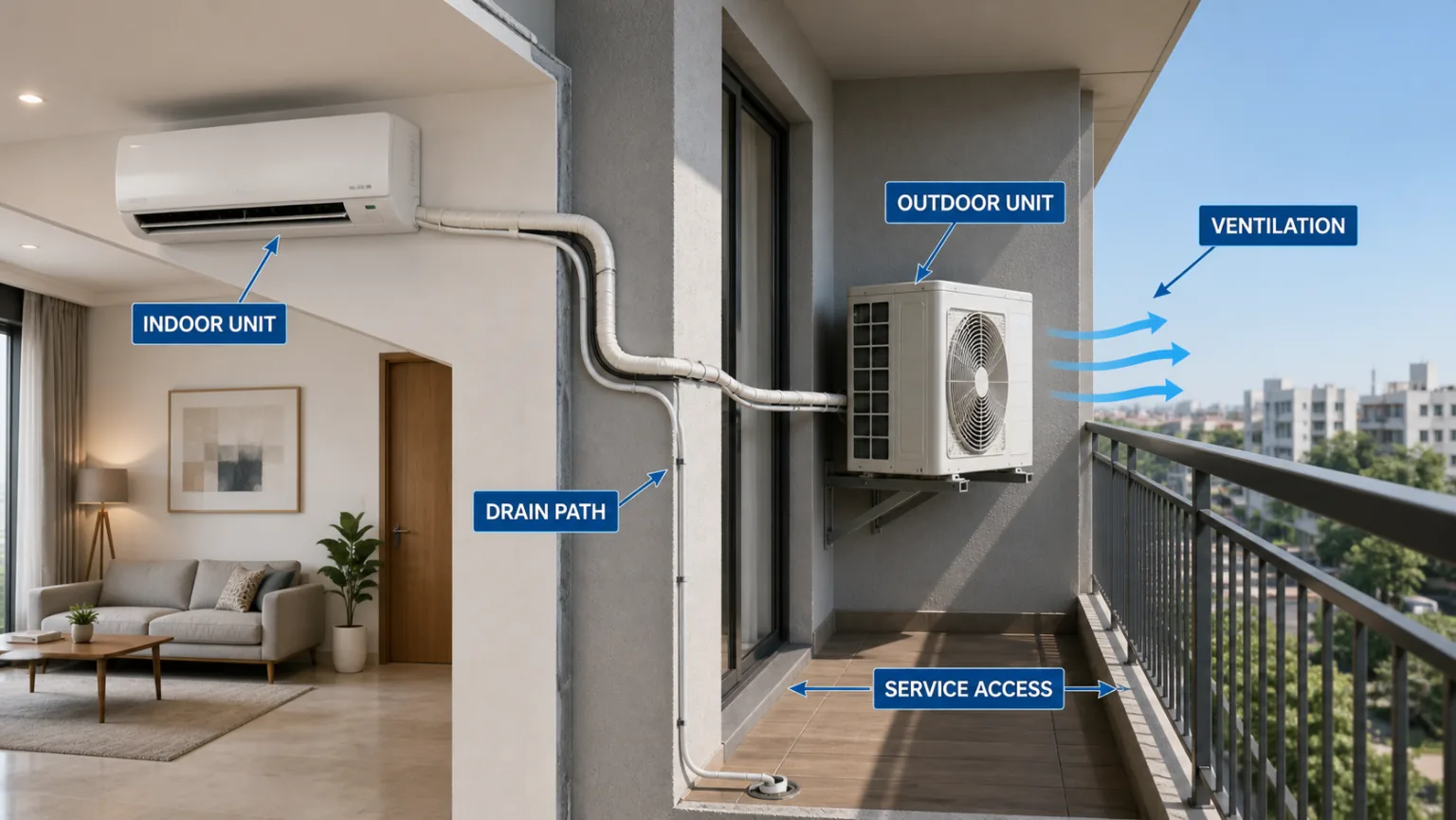
The outdoor condenser rejects heat, so it needs secure mounting, open ventilation and safe service access. Do not hide it inside a tight cabinet or let hot exhaust recirculate against a wall.
A balcony can work when airflow, drainage and society rules permit it. Keep exhaust away from seating and neighbours. Roof or ledge locations require safe technician access.
Obtain approval for façade drilling or brackets. Manufacturer, HVAC and building requirements take priority over Vastu preferences.
AC drainage and condensate
Condensate is normal; indoor dripping is not. Follow the approved drain route, keep it away from electrical systems, and discharge where water cannot stain walls or create a slippery surface.
Stains, odour, bubbling paint or water may indicate a blockage or insulation problem. Arrange service promptly and review Water Leakage Vastu for related maintenance checks.
AC placement by bedroom direction
The room’s compass direction does not automatically determine the AC wall. Use this table as a planning prompt, then test the actual airflow, sunlight and fixed services.
| Bedroom orientation | Practical planning focus | Balanced approach |
|---|---|---|
| North-facing bedroom | Often receives softer direct heat than west-facing rooms, but window size and climate still matter | Choose a clear wall that sends air across the room; do not block northern windows or curtains |
| South-facing bedroom | Check solar gain, exterior wall temperature and headboard position | A south wall is usable if installation is safe and airflow does not strike the bed directly |
| East-facing bedroom | Morning sun can warm the window side early | Coordinate blinds and AC throw so curtains do not obstruct the unit |
| West-facing bedroom | Afternoon heat can be intense, especially with large glass areas | Assess shading, insulation and equipment capacity instead of expecting direction alone to solve heat gain |
AC placement in apartments and high-rises
Builder points may not match the final bed or sofa. Review drain sleeves, electrical points, ledges and façade rules before buying furniture; use the Apartment Vastu guide for wider planning.
Renters need owner permission before drilling. In high-rises, use approved installers and society procedures for all outdoor work.
What if the AC point is already fixed?
A fixed point is common. Move the bed or sofa away from the strongest draft, redirect louvers, use swing mode and select a moderate temperature.
Keep curtains and filters clear. Use only a safe, manufacturer-compatible deflector approved by the installer; it must not obstruct return air or encourage condensation.
Do not move electrical or refrigerant lines without professional advice. Try furniture and airflow adjustments first, following the calm approach in Vastu Remedies.
15 common AC placement mistakes
- Direct airflow onto the bed: a cold stream across the face, head or chest can disturb sleep.
- Mounting directly above the headboard: this can combine draft, noise and difficult service access in one sensitive zone.
- Blocking the unit with a wardrobe: tall storage can interrupt both supply and return airflow.
- Hiding the AC behind decorative panels: concealed joinery may reduce efficiency and complicate cleaning.
- Ignoring the drain route: a poor path can lead to indoor leakage, stains and moisture damage.
- Enclosing the outdoor condenser: restricted ventilation prevents heat from escaping efficiently.
- Leaving no service access: filters, connections and the condenser must remain reachable.
- Installing above heat-producing electronics: this can complicate wiring and put devices below at risk if water leaks.
- Ignoring window heat gain: west sun and large glazing can overwhelm a placement chosen only for appearance.
- Blocking the air return: curtains, shelves and décor near the intake can reduce performance.
- Using an unsuitable electrical setup: extensions or improvised connections should never replace the specified safe supply.
- Putting furniture below a possible drip path: protect beds, sofas, televisions and storage from condensate risk.
- Ignoring vibration and noise: a weak wall or resonant bracket can affect sleep and neighbours.
- Choosing capacity by room direction alone: equipment sizing depends on heat load, area, volume, occupancy and insulation.
- Following Vastu while ignoring HVAC design: no traditional preference should override structural, electrical or manufacturer safety.
Practical AC installation checklist
Wall and structure
Confirm a sound mounting surface and check for concealed wiring, plumbing and beams before drilling.
Electrical safety
Use the supply, protection and isolation arrangements specified for the unit; avoid improvised extensions.
Drain path
Confirm where condensate will travel and discharge without leakage, staining or risk to electrical systems.
Outdoor ventilation
Keep the condenser’s intake and hot exhaust area open according to manufacturer requirements.
Airflow and furniture
Check the bed, sofa, TV, curtains, windows and wardrobes from the actual occupied positions.
Service access
Ensure filters, covers, connections and the outdoor unit can be reached safely for maintenance.
Before approving the installation, ask the technician to explain the indoor air path, drain route, outdoor heat rejection and service plan. Confirm the selected location against the manufacturer’s instructions. If one requirement conflicts with a directional preference, choose the safe installation.
Traditional Vastu belief vs practical HVAC guidance
| Question | Traditional Vastu view | Practical HVAC guidance |
|---|---|---|
| Preferred zone | Southeast or Northwest is commonly suggested | Use a suitable wall with safe services and effective air distribution |
| Comfort | Balanced direction and room flow are emphasised | Airflow pattern, temperature, humidity, noise and equipment sizing shape comfort |
| Outdoor unit | Direction may be considered when options are equal | Ventilation, secure mounting, heat rejection and safe access are essential |
| Remedy | Use calm, reversible adjustments when the ideal zone is unavailable | Redirect airflow, maintain filters, correct drainage and follow professional advice |
Vastu placement is a traditional belief, not a substitute for engineering. Room comfort depends on airflow, heat load, ventilation, insulation, equipment sizing and installation quality. Use direction as one planning layer, then let safety, manufacturer guidance and professional HVAC judgment decide whether the location is workable. Explore the full Room-wise Vastu guide when coordinating the AC with other room elements.
Frequently asked questions
Which direction is best for AC according to Vastu?
Traditional Vastu discussions commonly prefer the Southeast or Northwest zone for cooling equipment. In a real room, choose a structurally suitable wall that provides indirect, even airflow and meets the manufacturer’s installation requirements.
Which wall is best for AC placement?
The best wall is strong, unobstructed, close to a safe electrical point and workable drain route, with enough access for filter cleaning and service. Wall direction is secondary to these practical conditions.
Can AC be placed above the bed?
It is usually better to avoid placing the indoor unit directly above the headboard. Direct draft, noise, possible condensation and difficult service access can make this position uncomfortable even when installation is technically possible.
Can AC face the bed?
An AC can face the bed only if its airflow can be directed above or beside sleepers. Avoid a continuous cold stream across the face, head or chest, especially during sleep.
Where should AC be placed in a bedroom?
A side wall that sends air across the open part of the room often works well. Coordinate the indoor unit with the headboard, wardrobes, curtains, windows, drain route and service access.
Where should AC be placed in a living room?
Place it where air can circulate through the main area without blowing continuously into the faces of people seated on the sofa. Keep curtains, cabinets and decorative panels away from the unit.
Is Southeast good for AC placement?
Southeast is commonly preferred in traditional Vastu because it is associated with the fire element and electrical equipment. Use it only when the wall, drainage, airflow and maintenance conditions are also suitable.
Can an AC be installed on a south wall?
Yes, if the wall is structurally suitable and the airflow, drain route and service access work safely. The wall on which the unit sits is less important than where the air travels and how the equipment is installed.
Where should the outdoor AC unit be placed?
Choose a secure, well-ventilated location that allows heat to escape and gives a technician safe service access. Follow the manufacturer, HVAC technician, building society and façade rules.
Can the outdoor AC unit be kept on a balcony?
Yes, when the balcony has adequate ventilation, a safe mounting surface, suitable drainage and enough service space. Do not enclose the condenser tightly or aim its hot exhaust at seating or a neighbouring opening.
Is window AC placement different from split AC placement?
Yes. A window AC depends on a suitable exterior opening and projects through the wall or window, while a split AC offers more flexibility for the indoor unit but still needs piping, drainage and an outdoor condenser.
What if the builder has already fixed the AC point?
Keep the point if moving it is unsafe or impractical. Adjust the bed or sofa, use swing mode, redirect louvers, manage curtains and choose a moderate temperature so the air does not strike one person continuously.
Can an AC be installed above a door?
It may be possible when the wall has adequate strength and the unit remains accessible, but door movement, vibration, pipe routing and service access must be checked by a qualified installer.
What is the best AC placement in a small bedroom?
Use the least obstructed wall and direct the air across the open floor or toward the foot-side of the bed. Avoid squeezing the unit above a wardrobe or directly over the pillows.
Does AC direction matter more than airflow?
No. Direction may guide a traditional Vastu preference, but airflow, heat load, drainage, electrical safety, equipment sizing and professional installation have a greater effect on comfort and reliable operation.
Conclusion
Good AC placement begins with comfort: avoid direct draft, give air room to circulate, maintain a reliable drain path and keep the outdoor condenser ventilated. Southeast or Northwest may serve as a traditional Vastu preference when practical options are equal, but a direction should never override a safe wall, correct electrical work, manufacturer instructions or professional HVAC judgment.
If the builder point is fixed, use calm adjustments—furniture position, louvers, swing mode, curtains, moderate temperature and regular maintenance—before considering disruptive changes. Return to the VastuEssentials homepage to continue planning your home one practical decision at a time.