
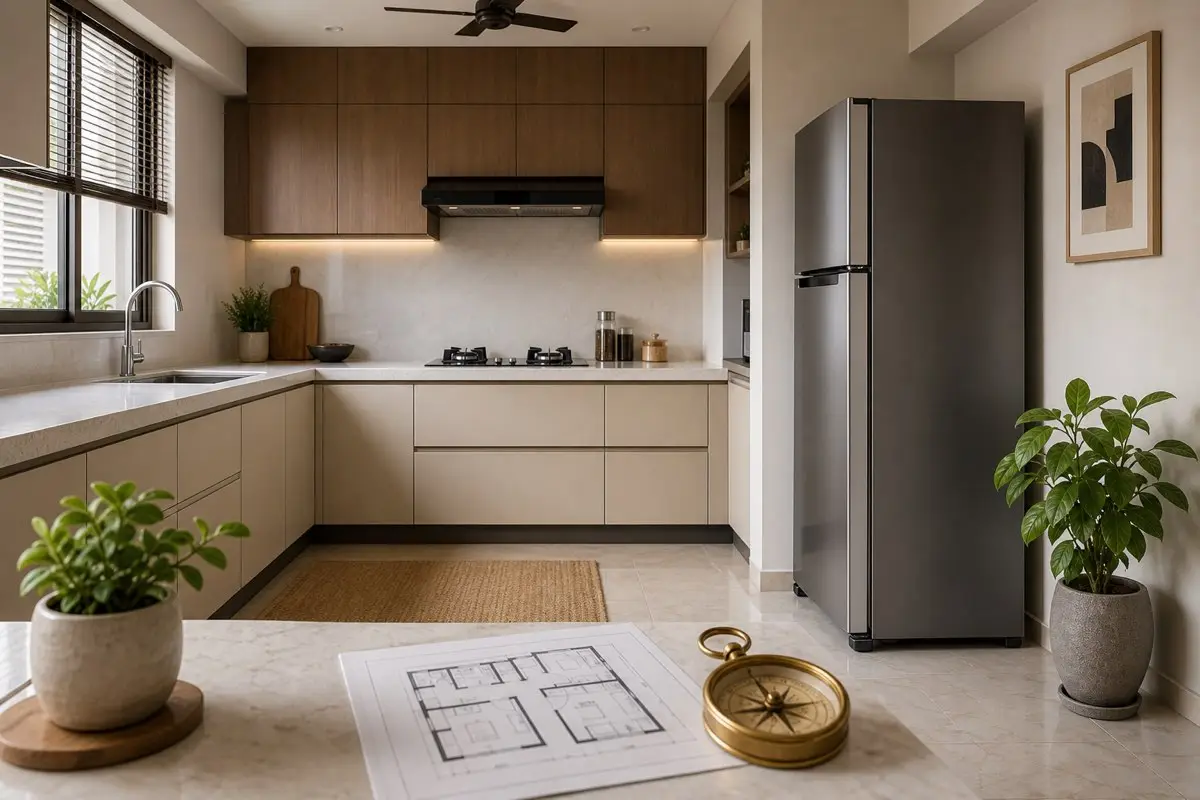
Why refrigerator placement matters
In traditional Vastu, the kitchen is strongly connected with fire, nourishment, health, and daily routine. A refrigerator is different from the stove because it stores cold food, water, vegetables, milk, and leftovers. It is also heavy, electrically active, and opened many times a day. Because of this, refrigerator placement should be planned with both Vastu and practical kitchen design in mind.
Modern Indian flats often have compact kitchens where the builder has already fixed the sink, stove, washing area, shaft, and electrical points. So the goal is not to create fear. The goal is to choose the most sensible wall, keep the appliance clean, avoid heat and water conflict, and make daily movement smooth.
Best direction for refrigerator in Vastu
Many Vastu practitioners prefer the south-west, west, or north-west side for heavy storage appliances like refrigerators, depending on the kitchen layout. The south-west is traditionally treated as a stable and heavy zone, while west and north-west can work well for storage and movement. In real homes, the best placement is usually a clean side wall away from the stove and sink.
Avoid placing the refrigerator so close to the stove that heat affects cooling performance. Also avoid placing it directly beside a wet sink where water splashes, leakage, and electrical risk can become a problem. If direction and safety conflict, safety wins first.
Placement grid for quick checking
Ideal zones
South-west, west, or north-west can work when the wall also supports ventilation and safe wiring.
Keep away
Avoid direct heat from stove, wet splash from sink, and blocked rear ventilation.
Best remedy
Clean expired food, clear the top, maintain airflow, and keep the refrigerator door clutter-free.
Kitchen layout and refrigerator triangle
Kitchen designers often use the work triangle: stove, sink, and refrigerator. Vastu readers can use the same idea in a practical way. The stove should remain the cooking focus, the sink should remain clean and functional, and the refrigerator should be easy to access without blocking the cooking path. If the refrigerator door opens into the main walking path, the kitchen will feel irritating every day.
In an L-shaped kitchen, place the refrigerator at the end of one arm when possible. In a straight kitchen, keep it at one side rather than in the middle. In an open kitchen, make sure the refrigerator does not dominate the living room view. For deeper fire-and-water balance, read Kitchen Vastu.
Colours, finish, and visual balance
White, silver, grey, black, beige, and muted metallic finishes are common and generally easy to use. A bright red or very loud refrigerator may not suit every kitchen because it becomes visually heavy. If the fridge is already a strong colour, balance it with calm cabinets, clean lighting, and less clutter on the door.
Avoid covering the refrigerator with too many magnets, bills, expired coupons, and random papers. A few useful notes are fine, but a crowded refrigerator front can make the kitchen feel restless. A premium kitchen often looks calm because surfaces are clear.
Common mistakes to avoid
The biggest mistake is placing the refrigerator beside the stove with no breathing gap. Heat makes the fridge work harder and can reduce efficiency. Another mistake is blocking ventilation at the back or sides. Refrigerators need space to release heat. Vastu should never encourage a placement that damages an appliance.
Do not keep expired food, leaking containers, old medicines, or spoiled vegetables inside. In Vastu language, stale food affects home energy. In practical life, it affects hygiene, smell, and family health. Clean the fridge weekly and deep-clean monthly.
Apartment and rental home tips
In apartments, the fridge point may already be fixed. If the location is not ideal, focus on correction instead of panic. Keep the fridge clean, ensure safe wiring, leave ventilation space, and avoid placing dustbins beside it. Use a side mat only if it does not block the door or create slipping risk.
In rental homes, do not shift heavy electrical points without permission. If the fridge must remain in a less-preferred zone, keep the area well-lit and uncluttered. Most refrigerator Vastu corrections are simple because the appliance is movable.
Buying checklist
Before buying a refrigerator, measure the wall, door swing, plug point, cabinet gap, and passage width. Check whether the main kitchen door, utility door, or balcony door will clash with the refrigerator door. Buy the size your family needs, not the biggest model you can fit.
For small flats, a slimmer refrigerator may support better flow than a large double-door model. For big families, choose capacity carefully but keep the placement practical. A well-sized appliance is more Vastu-friendly than a huge appliance that blocks movement.
Daily routine and food energy
The refrigerator silently influences family routine because it stores what people eat every day. Keep fresh food visible, remove expired packets, and avoid treating the fridge as a forgotten cold cupboard. In many Indian homes, leftovers, milk packets, spice pastes, batter, chutneys, vegetables, and medicines all compete for space. When the fridge is organised, morning cooking becomes easier and the kitchen feels more peaceful.
Use clear containers, label dates when needed, and clean spills immediately. Avoid keeping non-food clutter, old bills, and unrelated items inside or on top. Vastu discussions often speak about positive energy, but in a kitchen, positive energy begins with hygiene, freshness, and respect for food. A clean refrigerator supports both health and harmony.
No-demolition correction ideas
If the refrigerator is in a less preferred direction, start with simple corrections. Keep the surrounding wall bright, ensure the door opens smoothly, place a small clean mat only if needed, and keep the top surface clutter-free. Do not block the fridge with buckets, stools, or grocery bags. These practical corrections improve the feel of the appliance without shifting plumbing or cabinets.
If the refrigerator faces the stove directly in a compact kitchen, create visual and functional separation using a narrow counter gap, tall pantry unit, or careful scheduling of movement. If the fridge is near the sink, protect wiring and prevent splashes. If it is in the dining room, keep it visually neat so it does not reduce the elegance of the space.
Real-life Indian kitchen scenarios
In a 2BHK apartment, the refrigerator is often placed just outside the kitchen because the kitchen passage is narrow. This can work well when the dining corner is clean and the fridge does not block the main movement line. In an independent house, the refrigerator may sit inside a larger kitchen or pantry, which gives more freedom to choose a west or south-west side wall.
In a joint family home, the refrigerator is opened frequently, so access matters more than decorative symmetry. In a studio flat, it may be visible from the living area, so keeping the front clean becomes part of the design. In every case, check door swing, heat, water, ventilation, and family routine before worrying about a perfect textbook direction.
If a builder has provided only one plug point, do not use loose extension boards permanently. Ask an electrician for safe wiring if the appliance must move. Vastu should never create electrical risk. A safe, clean, easy-to-use refrigerator is always better than a forced placement that creates daily inconvenience.
Quick comparison table
| Check | Good practice | Avoid |
|---|---|---|
| Direction | Choose a suitable zone after checking the full room layout. | Following direction blindly while ignoring safety. |
| Maintenance | Keep the appliance clean, working, and easy to service. | Keeping broken, leaking, noisy, or dusty appliances. |
| Daily use | Support smooth movement and family routine. | Blocking doors, passages, windows, or furniture. |
Expert checklist before final placement
Before finalising the appliance position, stand in the room and test the real experience. Open the appliance door fully, walk around it, check nearby switches, look at the view from the entrance, and confirm that cleaning is easy. Then check whether the placement affects heat, water, airflow, sound, privacy, or daily movement. This simple test prevents most mistakes.
If the appliance is already installed, observe it for one week. Notice where clutter collects, whether anyone bumps into it, whether noise disturbs sleep or study, and whether maintenance access is easy. Vastu becomes useful when it improves real living, not when it creates fear. A calm, safe, clean, well-maintained appliance placement supports the home better than a theoretically perfect but uncomfortable arrangement.
Finally, take one photo of the room from the doorway. Photos reveal crowding, awkward gaps, dark corners, and visual imbalance that the eye may ignore in daily use. If the appliance looks too dominant, soften the area with cleaner storage, better lighting, and simpler surrounding décor.
Frequently asked questions
Which direction is best for refrigerator in Vastu?
South-west, west, or north-west are commonly considered practical options, but the final choice should also respect kitchen safety, wiring, ventilation, and door movement.
Can a refrigerator be near the stove?
It is better to avoid direct closeness because heat affects cooling and creates fire-cold conflict. Keep a safe gap or a cabinet divider if possible.
Can the fridge be outside the kitchen?
Yes, if the kitchen is too small. A dining side wall or pantry wall can work if the area is clean, accessible, and not blocking circulation.
What should not be kept on top of the refrigerator?
Avoid heavy clutter, broken items, medicine piles, and dusty storage. Keep the top clean or use very light organised storage only.
Related guides
Kitchen Vastu
Read the full guide here: Kitchen Vastu.
Home Vastu
Read the full guide here: Home Vastu.
Vastu Remedies Without Demolition
Read the full guide here: Vastu Remedies Without Demolition.
Direction Checking
Read the full guide here: Direction Checking.
Final thoughts
Appliance Vastu works best when tradition and practical planning agree. Choose a sensible position, keep the area clean, fix maintenance issues quickly, and avoid fear-based changes. A safe, neat, well-used appliance supports a more peaceful and premium home.