
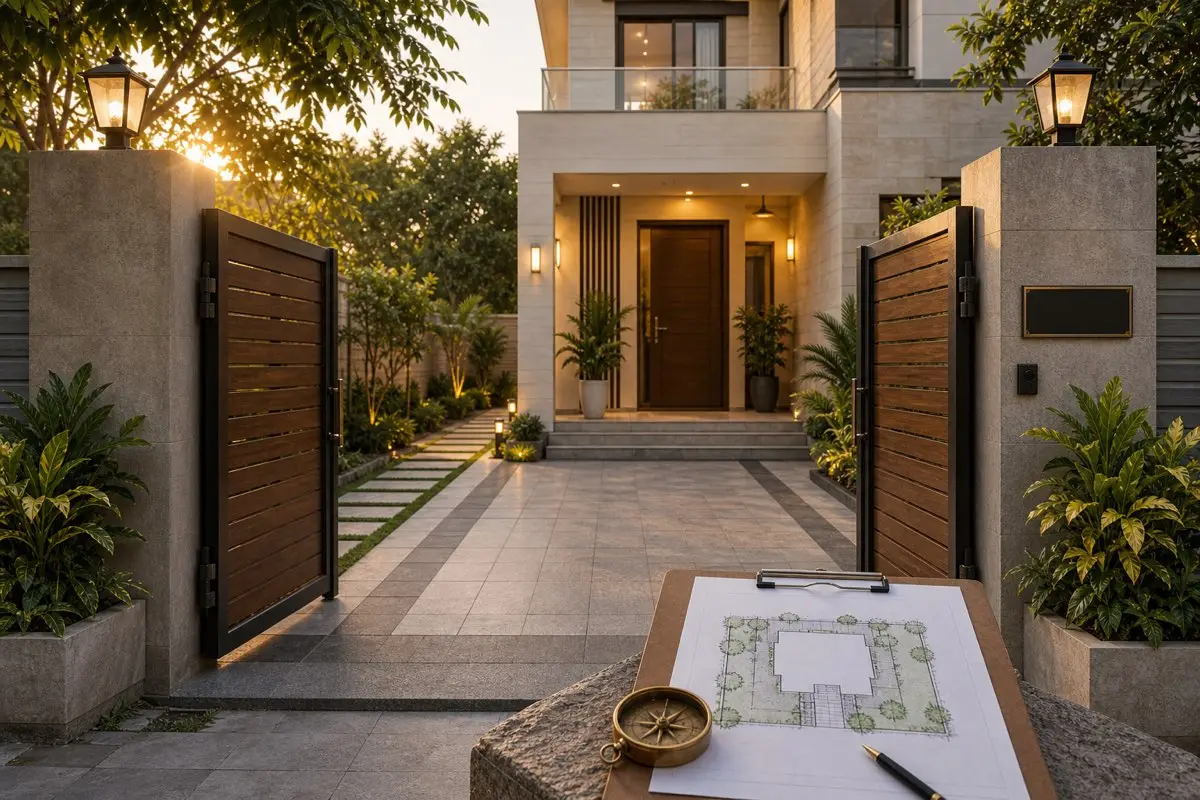
Why main gate Vastu matters
In Vastu, the gate is not the same as the main door. The gate belongs to the plot boundary, while the main door belongs to the building. Both influence movement, but they should be judged separately. A good gate makes entry clear, safe, and welcoming before anyone reaches the house.
Modern planning agrees with this idea. A gate must support vehicle turning, pedestrian safety, visitor visibility, delivery access, drainage, security, and privacy. A gate placed only for appearance can create everyday problems if cars reverse dangerously, rainwater enters, or guests cannot find the entrance.
Best direction and placement for main gate
Many Vastu traditions prefer selected zones in the north, east, or north-east for lighter and more welcoming entry, but the correct placement depends on road direction, plot facing, slope, traffic, and compound wall design. West and south gates can also work when planned carefully with proper placement and safety.
Do not assume the gate must sit exactly in the centre. Sometimes a slightly shifted gate creates better parking, privacy, and movement. Avoid placing the gate where road water flows directly into the plot, where a transformer or drain dominates the view, or where a vehicle cannot enter safely.
Main gate planning grid
Test the boundary entrance using the street approach and the parking arrangement together.
Vehicle approach
Check turning space, mirrors and the parked vehicle with the gate fully closed.
Walking route
Show where visitors wait and how they reach the house without crossing moving gate leaves.
Gate travel
Allow for the full swing or sliding run-back, including slopes and maintenance access.
Gate size, proportion, and opening style
The gate should be proportionate to the compound wall, house elevation, road width, and vehicle requirement. An overly large gate on a small plot can feel exposed, while a narrow gate can create parking stress. Sliding gates save swing space, while swing gates need clear opening area.
A pedestrian wicket gate can be useful when vehicle entry is not needed every time. Ensure the gate opens smoothly and does not hit plants, vehicles, steps, or public footpath rules. A premium gate is not only decorative; it is easy and safe to use.
Best colours and materials
Choose colours that suit the direction, house style, and climate. Wood tones, deep brown, muted green, white, cream, charcoal, bronze, and simple metal finishes often work well. Avoid overly aggressive colours if they clash with the home’s calm entry feel.
Materials should be durable and maintainable. Iron, steel, wood, aluminium, or composite gates can work if protected from rust, termites, and weather. Keep hinges, locks, wheels, and tracks maintained. A noisy, stuck, or rusted gate weakens the entrance experience.
Main gate do's and don'ts
A gate decision needs more than the opening width shown on an elevation.
| Do | Don't |
|---|---|
| Test vehicle access from the actual street approach. | Choose the opening only for facade symmetry. |
| Plan a clear pedestrian entrance where feasible. | Make visitors stand in the moving leaf's path. |
| Include drainage and track maintenance in the design. | Bridge a street drain without the necessary approval. |
| Have powered-gate safety assessed professionally. | Assume a remote control or single sensor makes it safe. |
Pathway from gate to main door
The path from the gate to the main door should be clean, bright, and easy to follow. Avoid clutter, broken tiles, water stagnation, dustbins, and thorny plants along the route. Good lighting makes the entrance feel safe in the evening.
A direct line from gate to main door is not always necessary. A gentle landscaped transition can improve privacy and beauty. However, the route should not feel confusing. Guests, deliveries, and emergency visitors should understand where to go.
Security, privacy, and street context
The gate must balance openness and security. A completely closed gate may protect privacy but can make the house feel guarded. A fully open grill gate may show too much of the interior. Use design, planting, lighting, and camera placement sensibly.
Study the street. If the road is busy, keep pedestrian entry safer. If the plot is at a corner, check visibility. If the road slopes toward the gate, plan drainage. Vastu placement should always respect the street reality.
Common main gate mistakes
Common mistakes include placing the gate only for elevation symmetry, ignoring vehicle turning, blocking the entry with shoe racks or dustbins, allowing water to enter from the road, and keeping broken name plates or lights near the gate.
Another mistake is confusing gate direction with house facing. The plot gate, compound wall, main door, and room layout all need separate review. A good gate cannot fix a poor internal plan, but it can improve arrival and movement.
Main gate questions for plotted homes
Does the boundary gate need to face the front door directly?
No. The pedestrian route may turn to provide privacy or fit the site. Make that route clear, accessible and separate from parking conflicts. Gate position and building entrance position are different design decisions.
Is a sliding gate always better on a small plot?
It avoids a swing arc but needs enough unobstructed run-back along the boundary and a suitable engineered support arrangement. Check trees, meters, drains and access to the moving mechanism before choosing it.
How wide should a vehicle gate be?
There is no reliable universal width for every home. Vehicle size, approach angle, street width, pillars and slope all matter. Have a designer test the actual vehicle route and applicable local requirements.
Should an existing south-side gate be relocated?
Not solely because of direction. If it serves the road approach safely and there is no demonstrated access problem, relocation may add cost without practical benefit. Traditional zone preferences are not evidence that the current gate causes harm.
Draw the approach, not just the gate opening
Include the opposite kerb, parked vehicles, gate pillars, driveway and final parking space on the site sketch. Check the approach from each permitted travel direction. The vehicle must clear the entrance and allow the gate to close without trapping a pedestrian route. On a tight site, ask a designer to assess the turning path rather than testing a risky manoeuvre in live traffic.
Keep tracks, hinges and drainage serviceable
A sliding track can collect leaves and grit; a swing gate can drag if its supports move. Record scraping, leaning, unusual noises and standing water for the installer. Follow the maintenance instructions and keep people clear of an unstable gate. Do not adjust rollers, supports or a powered mechanism yourself. Confirm that rainwater can be managed without obstructing public drainage or sending it onto neighbouring land.
Shared gates need shared access decisions
In an apartment complex, residents should report blocked pedestrian entrances, failed intercoms or unsafe vehicle movements to the building manager. Do not independently change a communal gate's controls or position for a private Vastu preference. For a rented independent house, agree with the owner who maintains the gate and how visitors, deliveries and maintenance workers gain access. Keep access arrangements usable when the usual keyholder is away.
Ask what happens during a power failure
Before accepting a powered gate, obtain operating instructions, servicing information and an installer demonstration of the approved manual-release procedure. Ask how authorised users enter and leave during a power failure and where they wait while the gate operates. Check the pedestrian entrance and intercom as separate items. A working remote-control demonstration is not evidence that the complete installation has been safety-assessed.
Powered-gate safety is a system issue
A moving gate can create trapping or crushing points near pillars, hinges and its sliding path. The UK's Health and Safety Executive guidance on powered gates explains that safe operation depends on design, protective measures and ongoing maintenance working together. A sensor alone is not sufficient evidence of safety. Have a competent installer assess the whole installation and local requirements; do not test its force with a person or bypass a faulty safety device.
Example: parking blocks the pedestrian entrance
In an illustrative villa, a longer replacement car fits through the gate but leaves its rear across the walking route when parked. Widening the gate would not solve this. The owner needs to review the parking position, available depth and pedestrian route together. A separate side entrance helps only if it leads to an unobstructed path. Test everyday arrivals, including someone carrying shopping while another person parks.
Resolve boundary constraints before ordering
Give the designer photographs of the road, a measured boundary plan and details of the vehicles using it. Ask about levels, visibility, public-footpath clearance and permissions before relocating pillars or changing an opening. Coordinate structural supports with the gate supplier and drainage design. Choose finishes after the access arrangement works; paint colour cannot correct a blind exit, inadequate run-back or unsafe powered mechanism.
Related guides
Entrance planning
Read Entrance & Main Door Vastu, Main Door Mistakes, and Main Door Pada Vastu.
Home layout
Use Home Vastu, Balanced Layout, and Direction Vastu.
Corrections
For existing homes, see Vastu Remedies Without Demolition, Direction Checking, and Vastu FAQ.
Plan arrival from street to doorstep
A main gate serves a plot boundary, not an interior room. Prioritise a workable vehicle approach, a clear walking route and maintainable hardware. Traditional placement preferences may guide flexible choices, but should not override street conditions, permissions or the safe use of the entrance.