
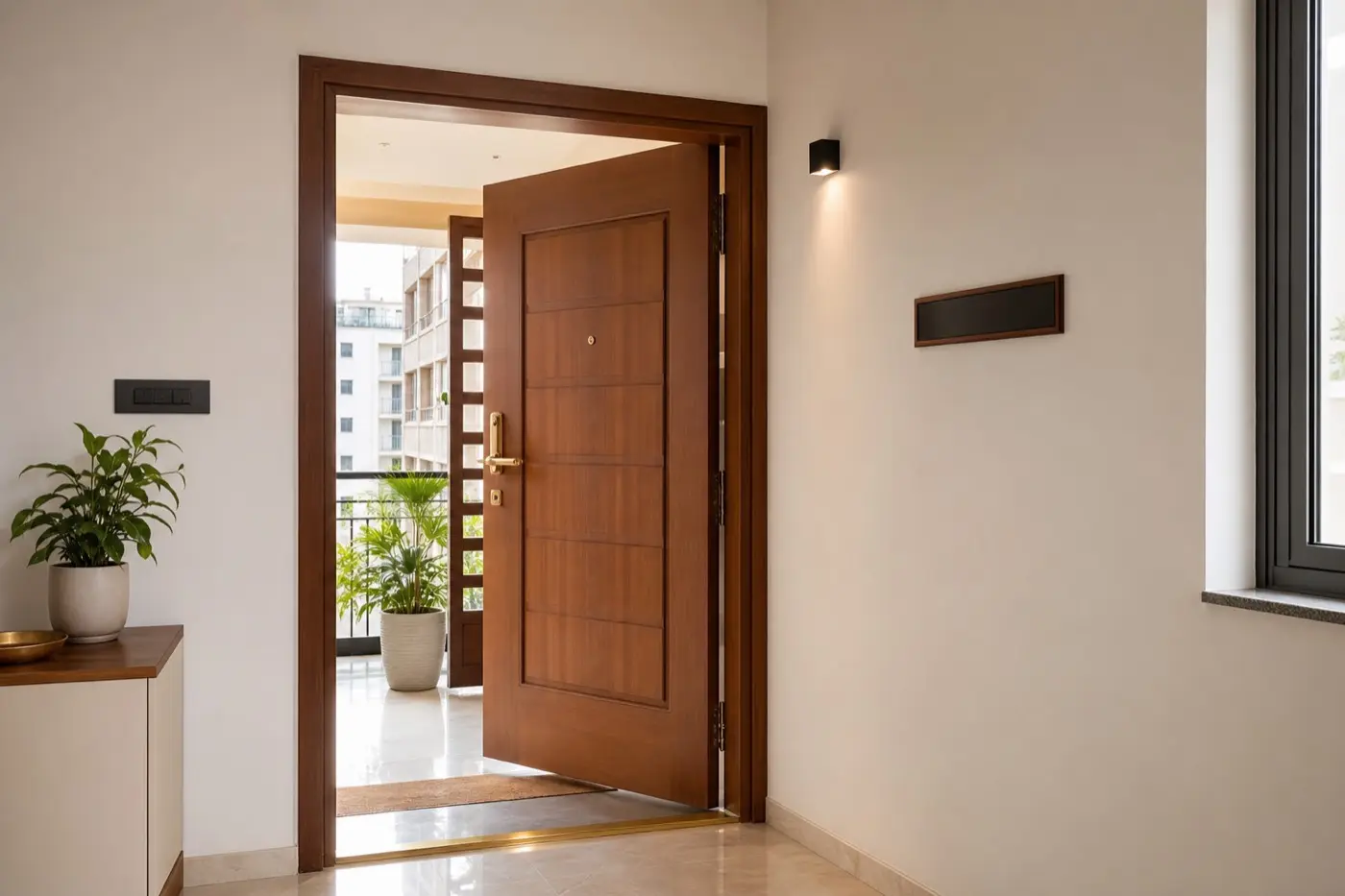
What does pada mean in main door Vastu?
In simple terms, a pada is a measured segment along an outer wall. Traditional planning systems divide each side of a plot or house into smaller zones so that a doorway can be described more accurately than merely “north-facing” or “east-facing.” Different schools use slightly different names and interpretations, but the practical lesson is consistent: the exact position of the entrance matters more than a broad sales label.
Imagine a 30-foot east wall. A door close to the north-east end and a door close to the south-east end both open toward east, but they influence circulation, sunlight, privacy, and internal room planning differently. The pada method encourages you to measure instead of guessing. It is a planning lens, not a substitute for structure, fire safety, local building rules, or comfortable daily use.
Direction
First confirm the wall's true compass orientation.
Position
Measure where the door sits along that wall.
Experience
Check light, movement, safety, and privacy.
Step 1: establish the correct direction
Stand inside the home at the main door and look outward. The direction you face is commonly used as the entrance-facing direction. Remove magnetic phone covers and move away from lift motors, electrical panels, parked vehicles, steel gates, and large appliances. Take at least three readings. If they differ widely, compare them with a traditional magnetic compass and the north arrow on the sanctioned drawing.
In an apartment, the tower entrance is not your flat entrance. A north-facing tower can contain flats with doors facing east, west, north, or south. Similarly, a balcony view does not define the main-door direction. Record the actual bearing in degrees rather than rounding immediately. A reading near a boundary needs more careful verification.
Check direction before fixing a metal security door. A heavy grill can disturb a phone compass and create confusing readings.
Step 2: measure the entrance position
Use the straight usable length of the exterior wall that contains the main door. Mark both end points on a plan. Measure the distance between them, divide that distance into equal segments according to the Vastu method you follow, and then mark the centre line of the door. The centre line—not the edge of the frame—shows the segment in which the opening mainly sits.
Real homes are rarely perfect rectangles. A recessed foyer, projecting column, service duct, or angled wall can change what should be measured. For a complicated façade, ask an architect to prepare a clean wall-line drawing. Do not divide a photograph by eye. A five-centimetre error on paper may become a meaningful shift when scaled to a long wall.
| Method | Useful for | Watch out for |
|---|---|---|
| Builder plan | Wall length and door centre | Plan may be mirrored |
| Site measurement | Finished, occupied homes | Include only the relevant wall line |
| Phone compass | Quick orientation check | Metal interference |
| Survey drawing | Plots and new construction | Confirm the north arrow |
How to read entrances on each side
Many contemporary Vastu consultants prefer selected northern and eastern segments because they can support morning light and an open arrival sequence. However, saying “all north doors are good” or “all south doors are bad” is an oversimplification. A well-positioned south or west entrance can function comfortably when the internal layout, shade, drainage, threshold, and circulation are handled thoughtfully.
For an east wall, give special attention to heat, glare, rain protection, and whether the door collides with the living room furniture. For a north wall, examine winter light, privacy, and the location of utility zones. West entrances benefit from a shaded porch and heat-resistant door finish. South entrances need effective weather protection, ventilation, and a clear transition so that harsh afternoon conditions do not enter the home unchecked.
North / East
Often preferred, but still verify the exact door segment and interior flow.
South / West
Not automatic rejection; assess shade, threshold, plan, and comfort.
Corner door
Check structural support, turning space, security, and boundary clearance.
Pada checks for apartments
Apartment owners usually cannot shift the structural opening. Focus on accurate diagnosis before considering remedies. Obtain the unit plan, confirm that it is not a mirrored marketing copy, mark magnetic north, and locate the centre of your door. Then inspect what the door opens toward. A clean, bright foyer with enough turning space often matters more in daily life than a tiny theoretical shift within one segment.
Keep the entrance easy to identify, well lit, and free from bicycles, rubbish bags, leaking shoe trays, or delivery cartons. Make sure the door opens fully and does not scrape the floor. If the corridor is dark, use a warm, reliable light. If privacy is weak, a slim internal screen can soften a direct view without blocking movement or emergency access.
Seven common entrance-checking mistakes
Wrong reference
Using the balcony, road, or tower gate instead of the flat door.
One compass reading
Trusting a phone beside steel, wiring, or a lift shaft.
Mirrored plan
Measuring a brochure layout that is flipped for another unit.
Door edge
Classifying the opening from one jamb instead of its centre.
Ignoring usability
Accepting a door that blocks furniture or creates unsafe circulation.
Fear-based remedy
Buying objects before confirming the actual direction and problem.
Improving an entrance without demolition
Start with maintenance: repair loose hinges, damaged laminate, broken locks, water seepage, and flickering lights. Keep the threshold even and safe. Choose a readable nameplate, a restrained doormat, and one healthy plant only if the corridor receives suitable light and the society permits it. Avoid crowding the doorway with symbolic products.
If the door position is considered less preferred by your tradition, improve the qualities you can control: clarity, light, cleanliness, proportion, ventilation, and calm movement. Use colour as a supporting design choice, not a magical cure. Warm wood, cream, muted green, and soft earthy shades are generally easy to live with. Fire-safety doors must never be drilled, cut, or altered without approval.
Checklist before buying a home
Carry a compass, measuring tape, printed plan, and pencil. Check the door bearing from inside, inspect the wall position, and compare it with the legal drawing. Visit during daylight and after sunset. Notice corridor noise, lift proximity, cross-ventilation, drainage smell, security, and whether shoes will obstruct the common passage. These practical observations protect your investment.
Finally, assess the complete plan. A supposedly excellent entrance does not cancel a dark kitchen, unsafe staircase, chronic leakage, poor ventilation, or an unaffordable loan. Vastu works best as one layer within responsible property due diligence.
Make the entrance work for the whole family
Observe the doorway during a normal busy hour. Children may leave school bags near the frame, older adults may need a grab point, and delivery workers may stand where the door swings. Provide a clear landing, non-slip flooring, visible house number, and enough light to identify visitors. If a wheelchair or pram is used, preserve the required clear width and avoid a raised decorative threshold that becomes a trip hazard. These details do not replace pada analysis; they complete it. A genuinely supportive entrance should be easy to approach, secure at night, protected from rain, and comfortable for every resident.
Frequently asked questions
How many padas are used for a main door?
Many systems divide a side into nine segments, while more detailed traditions use finer grids. Follow one consistent method rather than mixing charts.
Can I measure pada from a phone photo?
No. Use a scaled plan or physical measurement because perspective makes a photograph unreliable.
Is every south entrance bad?
No. Exact position, internal layout, climate response, and practical quality all matter.
Should I move an apartment door?
Usually not. Structural, fire, and society permissions come first; improve the foyer and internal planning instead.
What if the compass reading keeps changing?
Move away from metal, recalibrate the phone, take outdoor readings, and compare with the plan's north arrow.