
What is the Vastu Purusha Mandala?
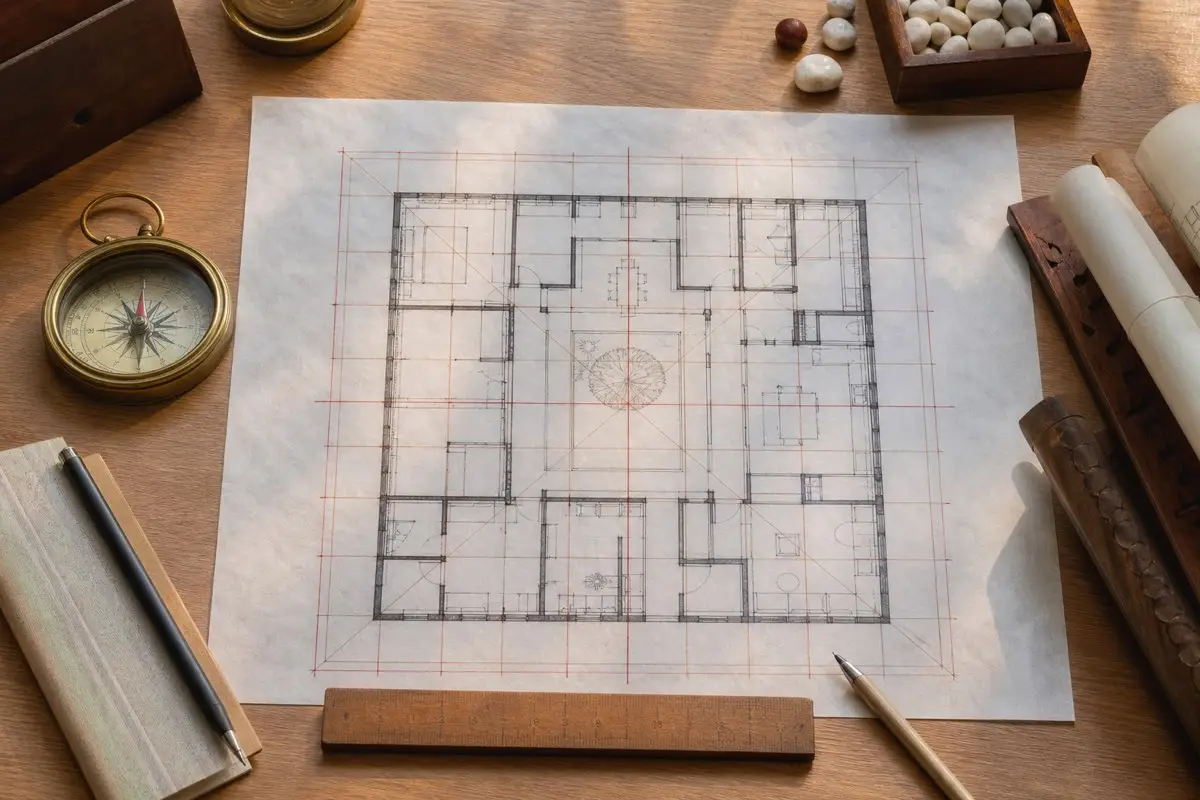
The Vastu Purusha Mandala is a square planning diagram used in traditional Indian architectural thought. “Vastu” relates to a dwelling or site, “Purusha” represents the organising presence within it, and “Mandala” means a structured geometric field. Together, the diagram offers a way to divide land or a building into directional zones and study how different activities may fit within them.
It is not a ready-made floor plan. It does not tell every family to build identical rooms. Instead, it gives architects and householders a reference for orientation, proportion, central space, edges, entrances, and relationships between functions. Climate, site shape, structure, local law, family needs, accessibility, and budget must still guide the actual design.
Direction
Connects rooms and openings with north, east, south, west, and intermediate zones.
Proportion
Uses a regular grid to study balance instead of placing rooms by guesswork.
Relationship
Encourages sensible links between entrance, centre, private rooms, and services.
The symbolic story behind the diagram
Traditional descriptions imagine the Vastu Purusha lying within the square, with the head associated broadly with the north-east and the feet toward the south-west. Deities or qualities are assigned to different cells in detailed versions. The story turns an abstract planning grid into a memorable cultural map.
For a modern reader, symbolism can be understood alongside observation. Morning light generally arrives from the east, north light is often softer, the south and west may carry stronger afternoon heat, and the centre naturally becomes a circulation focus. The diagram therefore invites a conversation between tradition and environmental design rather than demanding blind imitation.
Common Mandala grid formats
Vastu texts and building traditions use different square divisions. A simple grid may help with early zoning, while more detailed layouts divide the site into many padas or cells. The frequently discussed 8-by-8 and 9-by-9 arrangements are planning frameworks, not competing internet remedies. The correct format depends on the building type, tradition, and adviser.
For a homeowner, the exact number matters less than using one method consistently. Mixing a nine-part room chart, a detailed deity chart, and an unrelated entrance chart can produce contradictions. Mark north accurately, establish the true building outline, locate the centre, and then use a single coherent grid for discussion.
| Grid idea | Typical use | Homeowner takeaway |
|---|---|---|
| Simple directional zones | Early room planning | Useful for a first concept |
| 8 × 8 grid | Traditional architectural study | Needs knowledgeable interpretation |
| 9 × 9 grid | Detailed pada analysis | Do not treat every cell as a room |
| Irregular overlay | Existing apartments | Use the real usable footprint |
How the eight directions are commonly interpreted
North-east is often associated with openness, water, contemplation, and prayer. East is connected with morning light and arrival. South-east is linked with fire and therefore commonly preferred for kitchens. South is treated as a zone needing measured openings and heat control. South-west is associated with stability and heavier private use. West can suit dining, study, storage, or bedrooms depending on the plan. North-west is linked with movement and is often considered an alternative kitchen or guest zone. North is associated with lightness, work, and financial activity.
These associations are broad. A south-east kitchen without ventilation is not automatically successful, and a north-east living room with mould is not beneficial. Directional preference should be translated into good daylight, airflow, safe services, privacy, storage, and comfortable circulation.
North-East
Keep relatively light, clean, and open where the plan permits.
South-East
Often chosen for cooking, electrical equipment, and active work.
South-West
Often used for the main bedroom, heavy storage, or stable functions.
North-West
Can support guests, utility movement, parking, or an alternative kitchen.
Centre
Keep circulation legible and avoid unnecessary congestion.
Edges
Coordinate windows, shade, plumbing, structure, and access.
Understanding the Brahmasthan
The central zone is commonly called the Brahmasthan. Traditional guidance prefers it to remain open, light, or at least free from oppressive mass. In a courtyard house this may be a literal open court; in an apartment it may simply be the living-dining circulation area.
Modern homes cannot always leave the centre empty. The practical aim is to avoid turning it into a blocked store, poorly ventilated toilet, or confusing junction. Columns required by the structural engineer are not a Vastu failure. Use ceiling treatment, lighting, and furniture planning to keep movement calm without altering structural members.
Find the geometric centre from the actual enclosed footprint, not from a balcony, parking bay, or decorative projection unless your chosen method specifically includes it.
How to apply the Mandala to a new house plan
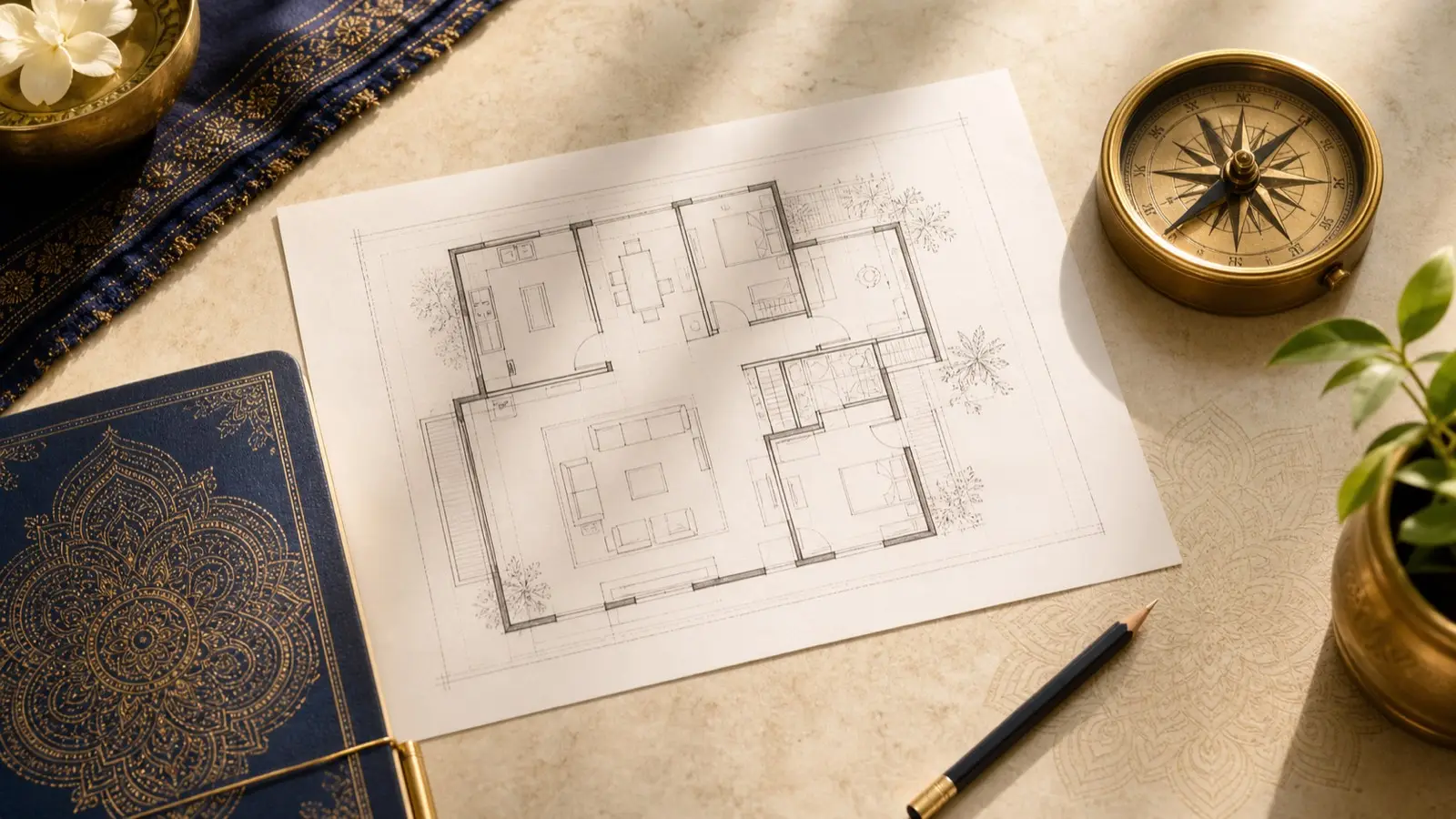
Begin with a legal survey and a drawing that shows north. Establish the buildable footprint after setbacks. Overlay a square or rectangular grid on the proposed building, then mark the centre and eight directions. Place major functions broadly before drawing furniture: entrance and living spaces, kitchen and utility, bedrooms, toilets, staircase, prayer, storage, and parking.
Next test each decision against daily life. Can groceries move easily from parking to kitchen? Does a bathroom ventilate outdoors? Can an elderly person reach a bedroom without climbing stairs? Is the kitchen exhaust safely routed? Does the entrance open fully? A Mandala-based plan succeeds only when directional logic and human usability support each other.
Using the grid in apartments and irregular homes
For a flat, apply the grid to the internal usable unit rather than the entire tower. Confirm whether the builder plan is mirrored. Include enclosed rooms and circulation consistently; treat balconies and shafts according to the method you have chosen. Do not move fire-rated doors, columns, ducts, or plumbing stacks merely to make the grid look neater.
In an L-shaped or irregular home, first identify the main mass and missing or extended zones. An architect can help divide the footprint accurately. Focus on improving actual qualities—light, cleanliness, ventilation, privacy, and safe movement—before buying symbolic remedies for every cut corner.
Common Mandala planning mistakes
Wrong north
Using the top of a brochure as north without checking the north arrow.
Mixed systems
Combining unrelated grids and internet charts until every answer conflicts.
Ignoring scale
Drawing zones on a photograph instead of a measured plan.
Fear of the centre
Trying to remove safe structural columns or useful circulation.
Room labels only
Forgetting windows, doors, furniture, drains, and service access.
Perfect-grid obsession
Sacrificing safety and comfort for a visually perfect diagram.
Working with an architect in a modern project
Share the Mandala requirements at the beginning of design, not after structural drawings are complete. Give the architect a written list of family needs and the Vastu preferences you value most. The architect can test options for entrance, kitchen, bedrooms, stairs, toilets, parking, services, and future expansion while the plan remains flexible. Ask for furniture layouts and daylight studies rather than approving empty room boxes.
A useful review should compare at least two schemes. One may follow the grid closely but create a long corridor; another may improve ventilation and accessibility while shifting a room slightly within the same broad zone. Discuss the trade-off openly. Vastu planning works best when it shapes architecture early instead of becoming a late checklist that forces costly changes.
Mandala principles beyond houses
The grid can organise offices, shops, clinics, schools, and community buildings, although their functions differ from a residence. A shop needs customer visibility, stock movement, billing security, fire exits, and deliveries. A clinic needs hygiene, privacy, accessible circulation, and medical services. Directional zoning may inform the plan, but statutory requirements and professional standards remain decisive.
On a plot with several structures, study the site Mandala and each building separately. Parking, guard rooms, septic systems, rainwater harvesting, landscape, and service yards influence the property. Do not stretch one small house chart across a complex campus and assume every cell has the same meaning at every scale.
A practical Mandala review checklist
Base drawing
Use a measured plan with verified north and scale.
Footprint
Define included rooms, balconies, and projections consistently.
Centre
Inspect movement, structure, light, and clutter.
Major zones
Review entrance, kitchen, bedrooms, prayer, toilets, stairs, and water.
Reality test
Overlay furniture, doors, windows, plumbing, and storage.
Final priority
Protect safety, legality, accessibility, and structural integrity.
A consistent grid also makes later reviews easier for architects, contractors, and family members.
Frequently asked questions
Is the Vastu Purusha Mandala a floor plan?
No. It is an organising grid used to develop and evaluate a plan.
Which direction is the head of Vastu Purusha?
Traditional representations commonly associate the head with the north-east.
Can the Mandala be used for flats?
Yes, but apply it consistently to the actual flat footprint and respect structural restrictions.
Must the Brahmasthan be completely empty?
No. Aim for openness and clear circulation; safe structural elements remain necessary.
Does every architect use the same grid?
No. Traditions and project types vary, so use one clearly explained method.