
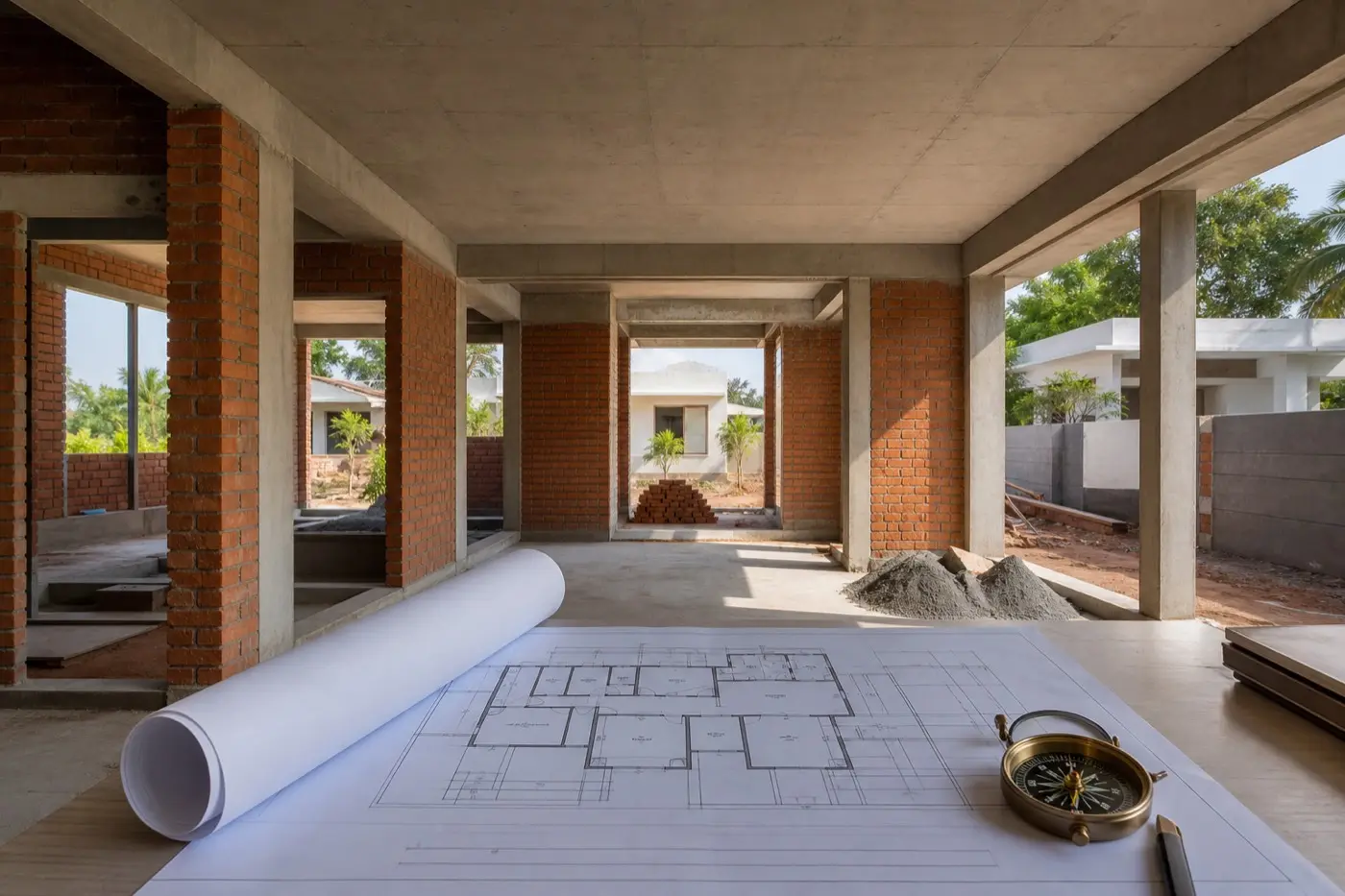
Before excavation: verify the basics
Begin with documents, not remedies. Confirm plot boundaries through a licensed survey, check setbacks, road levels, easements, drainage, soil condition, and local approval requirements. Mark true or magnetic north consistently on every drawing. A plan that rotates between the architect's sheet, structural sheet, and contractor's print can create expensive errors.
Traditional Vastu generally values a regular plot, clear access, balanced open space, and sensible movement of water. Modern planning adds equally important questions: can rainwater leave safely, will the ground floor flood, is the soil suitable for the proposed foundation, and can emergency vehicles approach? Never change foundation or column decisions without the structural engineer.
Legal
Title, survey, setbacks, approvals, and service connections.
Technical
Soil test, levels, structure, drainage, and climate response.
Vastu
Orientation, zoning, entrance, central space, and room relationships.
Stage 1: create a realistic family brief
List who will live in the home now and five to ten years later. Include elderly parents, children, working-from-home needs, guests, vehicles, domestic help, storage, pets, prayer, and accessibility. A plan can look ideal on a direction chart yet fail because it has no pantry, laundry area, wheelchair turning space, or privacy.
Decide priorities in order. Life safety, structure, ventilation, daylight, sanitation, and legal compliance are non-negotiable. Then place major rooms using Vastu preferences where the site allows. Finally refine furniture, colours, and decorative details. This hierarchy prevents a minor belief from overriding a major functional need.
Stage 2: review the concept plan
Many Indian Vastu traditions prefer a lighter, open north-east, a kitchen toward south-east with north-west as a common alternative, and a stable master bedroom toward south-west. The centre is often kept relatively open and free from heavy toilets, stair cores, or dense storage. These are broad principles; dimensions, climate, neighbours, and road position determine how they can be applied.
Check adjacencies. The kitchen should connect conveniently to dining and utility spaces. Toilets need plumbing efficiency and ventilation without opening awkwardly toward dining or prayer areas. Bedrooms need privacy from the entrance. A pooja corner should remain clean and calm. Stairs require safe risers, handrails, headroom, and natural light—not only a preferred clockwise direction.
| Zone | Common preference | Practical test |
|---|---|---|
| Entrance | Selected north/east segments | Safe approach and full door swing |
| Kitchen | South-east; north-west alternative | Exhaust, work triangle, plumbing |
| Master bedroom | South-west or west | Privacy, heat control, furniture |
| Pooja | North-east or calm east/north zone | Clean, ventilated, respectful |
| Toilets | Away from centre and prayer | Leak-proof, ventilated, serviceable |
Stage 3: freeze structure before masonry
Ask the architect to overlay the furniture plan on the column grid. A column in the middle of a bed, dining passage, wardrobe, or parking bay is easier to correct on paper. Beams should not create dangerously low headroom. Traditional advice may discourage a prominent beam above a bed or work desk; practically, an aligned ceiling or furniture shift can reduce visual pressure without touching the structure.
Do not move columns after excavation merely to satisfy a room diagram. Structural continuity governs earthquake and wind safety. If a preferred room zone conflicts with the safe structural grid, revise partitions or furniture—not engineering calculations on site.
Never ask a mason to relocate a column, cut a beam, or reduce steel based on an unapproved Vastu suggestion.
Stage 4: wall and opening checks
Before brickwork reaches lintel level, mark every door, window, niche, appliance, and wardrobe on the floor. Walk through the imaginary rooms. Confirm that the main door is proportionate and protected from rain. Check whether bedroom doors expose beds, bathroom doors face dining seats, or a wardrobe blocks a window.
Natural ventilation usually needs openings on more than one side or an effective shaft. Larger north and east openings are often associated with traditional guidance, but western and southern windows can also work well with chajjas, fins, trees, insulated glazing, or verandas. Climate-responsive shade is more useful than blindly closing a hot side and creating a dark room.
Stage 5: plumbing, electrical, and fire planning
Service drawings deserve the same attention as room directions. Coordinate underground and overhead water tanks, septic systems where applicable, rainwater harvesting, solar panels, air-conditioning drains, geysers, exhaust fans, inverters and battery backup, and EV charging. Traditional preferences often place underground water toward north or north-east and heavier overhead storage toward west or south-west, subject to engineering and municipal rules.
Keep electrical distribution boards accessible, dry, and away from gas cylinders. The cooking hob, sink, refrigerator, and storage should form a comfortable workflow. Provide enough sockets so extension boards do not cross passages. Bathrooms need waterproofing tests, floor slopes, traps, exhaust, and safe electrical protection. No Vastu object can remedy hidden leakage.
Kitchen
Fix hob, sink, exhaust, refrigerator, and gas route before tiling.
Bathrooms
Test waterproofing, slopes, ventilation, and access panels.
Energy
Plan daylight, fans, AC drains, solar, inverter, and EV load.
Stage 6: colours, finishes, and fixed furniture
Use colours to support the room's purpose and available light. Soft warm neutrals, pale greens, restrained blues, and natural wood are easier to live with than rigid direction-only colour charts. A dark bedroom may feel heavy even if its colour is theoretically assigned to that zone. Test large samples in morning and evening light.
Keep the entrance clear, the kitchen easy to clean, and the central circulation uncluttered. Heavy cupboards work best on structurally suitable solid walls without blocking airflow. Mirror placement should serve dressing and daylight without creating uncomfortable reflections from the bed. Fixed furniture drawings must show socket heights, skirting, handles, and door swings.
Stage 7: pre-handover inspection
Inspect the home in daylight and after rain if possible. Test every tap, drain, socket, lock, window, exhaust fan, and appliance point. Look for hollow tiles, damp patches, cracked sealant, reverse bathroom slopes, blocked weep holes, and unsafe railings. Compare the built home with approved drawings and collect warranties, test certificates, and service maps.
Then review the Vastu plan calmly. Confirm direction, entrance, room use, bed orientation, cooking position, and prayer space. Minor furniture changes are normal. Avoid panic if construction varies by a few centimetres; the home should be safe, healthy, comfortable, and maintainable first.
How to prevent expensive late changes
Set formal review gates: concept approval, structural approval, masonry marking, service layout, and furniture layout. Sign dated drawings at each stage. Ask every consultant to write changes rather than giving verbal instructions. Maintain one updated site set so workers do not build from an old WhatsApp image.
Reserve contingency money for genuine site conditions, not repeated belief-driven revisions. If family members follow different Vastu schools, agree on one qualified adviser before design begins. Mixing contradictory charts halfway through construction is a reliable way to waste time and materials.
Keep a simple site record
Photograph concealed plumbing, electrical conduits, waterproofing layers, and reinforcement before they are covered. Label each image by floor, room, and date. Record compass orientation, final room dimensions, paint codes, tile batches, valve positions, and appliance loads in one handover folder. This information is invaluable when you later drill a wall, repair a leak, add solar equipment, or sell the property. It also keeps Vastu decisions traceable: the family can see why a room was placed in a certain zone instead of relying on memory. Good documentation turns a thoughtful design into a home that remains easier to maintain.
Frequently asked questions
When should a Vastu review begin?
Ideally during the concept plan, before the structural grid and plumbing are frozen.
Can the kitchen be north-west?
Many traditions treat north-west as a practical alternative when south-east is unavailable.
Should the centre be completely empty?
Not necessarily. Keep it light and easy to circulate through; structural needs still govern columns.
Can Vastu change structural design?
Only through the licensed architect and structural engineer. Never alter structural members on site informally.
What is the most important final check?
Safety, waterproofing, ventilation, drainage, and legal compliance come before decoration.