
Balcony Privacy Vastu: How to Block the View Without Blocking Daylight
By VastuEssentials Editorial Team • Last updated:
Find out where the unwanted view comes from, then compare seating changes, blinds and screens that keep daylight coming in.
A balcony can look generous on a floor plan and feel surprisingly exposed the first time you sit down with tea. Across the gap, another tower has windows at the same height. From the living room, you notice that anyone looking straight across might also see your sofa. The obvious response is to cover the entire railing or keep the curtains shut. But that can leave the room behind the balcony darker all day.
The better first move is to block the specific view that bothers you, not the whole opening. Find out whether the privacy problem affects the balcony seat, the room indoors, or both. Then adjust the chair, try an indoor blind, or investigate an approved partial screen. This fits the traditional Vastu preference for an open, orderly balcony without treating an exposed view as a defect.
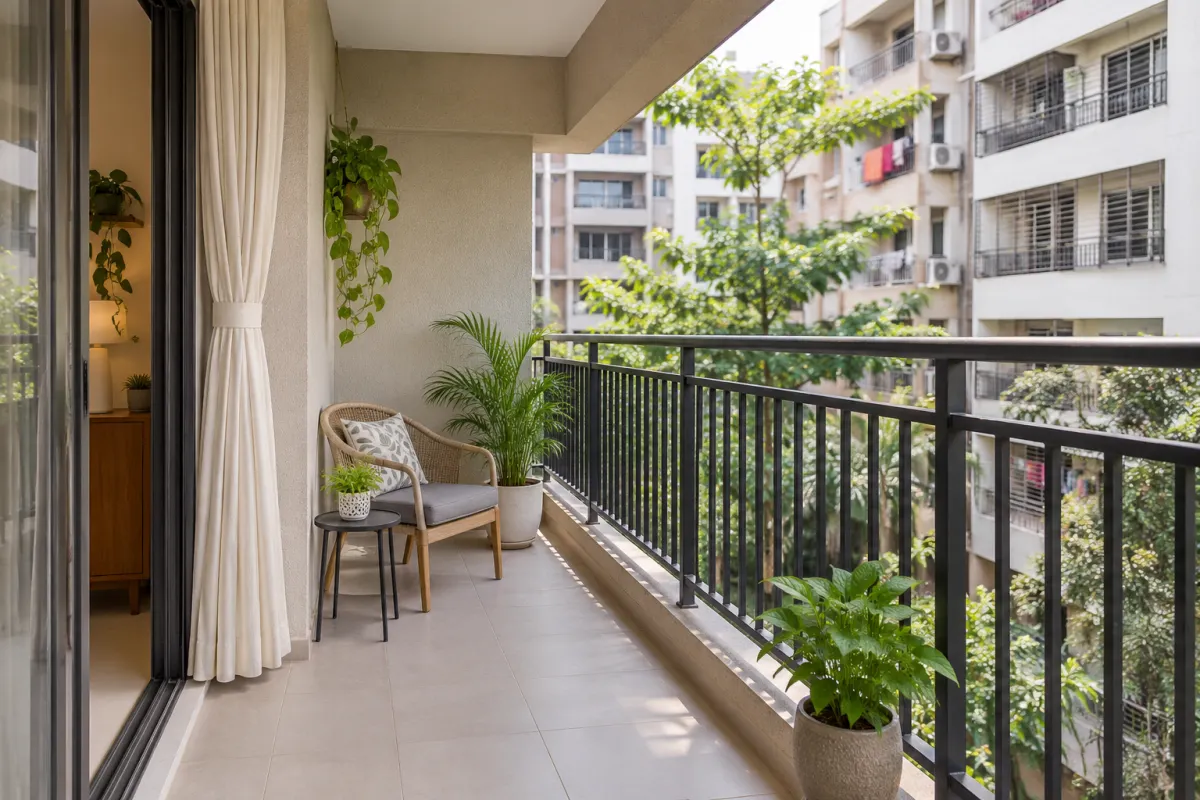
Does balcony direction matter for privacy?
Many traditional Vastu approaches prefer keeping north and east openings relatively open. If your family follows that approach, use it as a reason to try a reversible or partial solution before blocking the frontage. It is not a reason to sit somewhere you feel exposed, and it does not tell you which window across the courtyard can see your chair.
Orientation, sunlight and privacy are separate questions. An east-facing balcony may still be shaded by an opposite tower. Two west-facing balconies on different floors may need very different treatments because one is under a deep slab and the other faces an open road. Note the actual light where you sit before choosing a product. If you are unsure which way the opening faces, start with how to check directions correctly and compare a reading with the floor plan. The balcony's direction is not necessarily the flat’s entrance direction.
Look behind you as well. In a deep living room, the balcony door may be the main source of daylight. In a corner flat with windows on two sides, you may have more freedom to shade one opening. The living room Vastu guide can help you think about the seating and walking route as part of the same layout rather than as a separate decorating decision.
Find the sightline before shopping
Check both sitting and standing positions
Sit where you plan to drink tea or read. Note whether the exposure comes from across the courtyard, from a side balcony, or from windows higher up. Then stand at the sliding door and check what is visible. A low screen might help someone seated, but it will not necessarily protect a standing person by the doorway. A covering at railing height also may do little for a view from above.
Try moving your chair to the opposite end or turning it towards a solid wall. Use the chair you already own, even if you eventually want different furniture. Sit down, stand up and open the balcony door with the chair in place. If you can no longer carry laundry through easily, you have traded one everyday problem for another. The best location may turn out to be just inside the doorway rather than next to the railing.
Repeat the check after dark
A sheer curtain can feel private when the sun is outside, yet show silhouettes when your room is lit and the courtyard is dark. Test your normal evening lighting, including the lamp you use near the sofa. Ask someone in your household to look from a place they are allowed to stand, at a relevant angle. Do not photograph neighbours or assume their view is identical to yours. If you cannot test it directly, use an opaque indoor layer at night rather than relying on a translucent material.
Test the smallest area you need to cover
Hold a piece of cardboard indoors against one section of the glass while someone else sits in the usual spot. This shows whether a narrow band or one sliding-door panel would help. Check from the back of the room, too: a covering that looks modest from the balcony may shade the only bright patch where you read or work. The cardboard is just an indoor test. Do not attach it to a railing or leave it outdoors.
Compare balcony privacy options
Change the seat first
Best for a view from one side. It costs nothing to test and preserves daylight. It won’t help much if the opposite building looks straight into the living room.
Treat the glass indoors
Best when people are visible through the balcony door. Choose separate day and night layers if a sheer isn’t enough. Keep cords and operating hardware safe around children.
Consider an approved side screen
Best when the problem comes from one adjacent balcony and furniture changes don't resolve it. In exposed flats, ask building management about permissible products and professional installation before buying.
| Option | What it can solve | What to check |
|---|---|---|
| Repositioned seating | Exposure at the seat from a single angle | Door clearance and a usable path |
| Indoor blind or curtain | People seeing into the room through the glass | Daylight, nighttime opacity and door access |
| Partial frosted film | An identifiable view through part of the glazing | Glass compatibility, permission and silhouettes |
| Approved exterior screen | Side exposure that indoor shades cannot address | Wind exposure, drainage and maintenance access |
Plants are useful when you want a softer edge rather than reliable privacy. One stable plant well inside the balcony may interrupt a narrow sightline, but it won't hide a room at night or replace any barrier. Avoid hanging planters over the railing and avoid arranging pots or chairs where they could make it easier for a child to climb. If the safest position does not solve the view, choose an indoor treatment instead of adding taller, heavier pots.
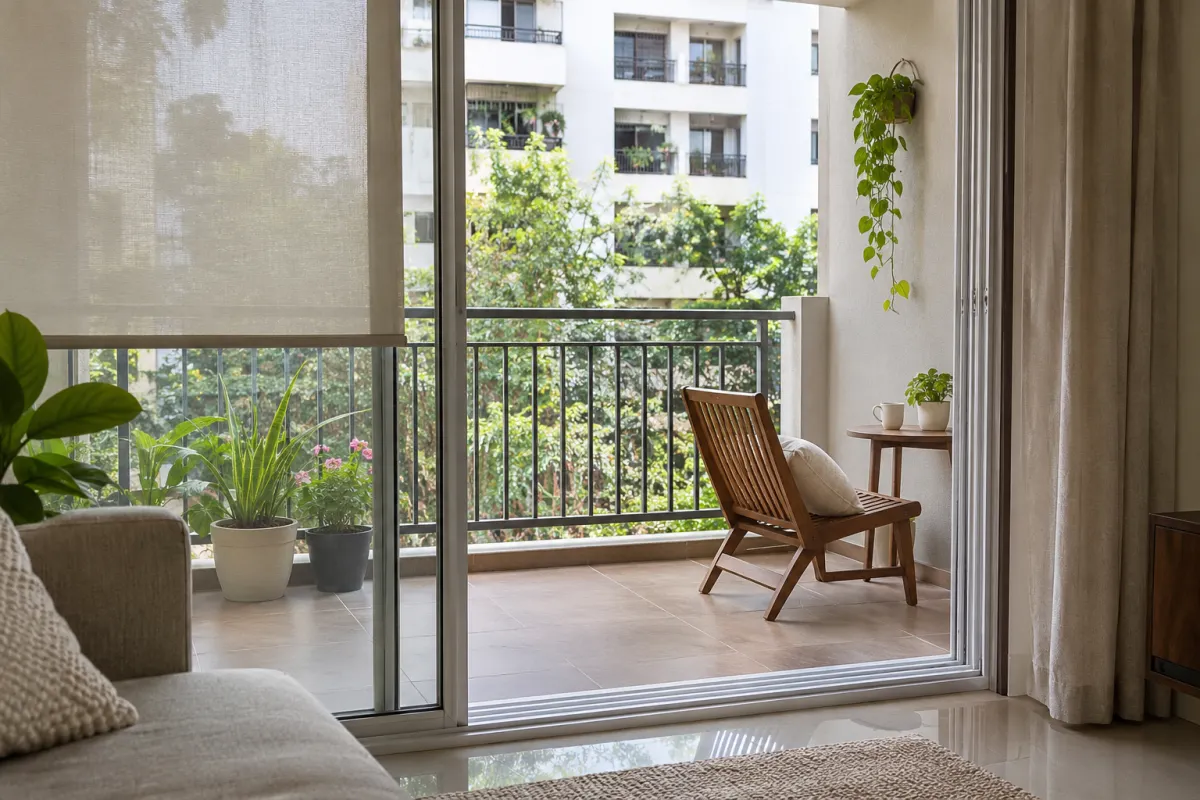
Three apartment examples
These illustrative scenarios show how different sightlines call for different fixes.
A Pune rental with side exposure
A tenant enjoys a north-facing balcony, but the neighbouring balcony is only a short distance to the right. A full blind across the front would block the part with the best view without doing much about the neighbour. She tries the left end of the balcony, with her chair turned slightly inward. From the new seat, the dividing wall breaks the direct sightline; the front stays open. That is enough during the day. For evenings, she closes the existing living room curtain rather than changing the exterior. See the rental home Vastu guide for other reversible changes.
A Bengaluru flat where the courtyard sees into the sofa
A couple thinks the exposed balcony itself is the problem. After checking from the sofa and doorway at dusk, they realise they rarely sit outside; they mainly want to use the living room in privacy after dinner. They test an opaque indoor blind on the glass panel directly opposite the sofa. The second panel stays uncovered during the day. On nights when silhouettes are still visible from an angle, they use a full indoor curtain. Here, a permanent screen on the railing would have solved the wrong problem.
A higher-floor Mumbai balcony exposed during rains
A family wants a bamboo screen after seeing a similar one on a sheltered ground-floor terrace. Their balcony is more exposed, and rain regularly washes leaves toward the drain. Before purchasing anything, they check whether their building allows exterior screening and whether suitable fixings can be installed professionally. While they wait for an answer, they try an indoor blind and keep the drain accessible. That gives them privacy at night without committing to a product that may be hard to maintain through monsoon weather.
Check these details before buying or installing
- Target one view. Write down what you want to hide, from which angle, and at what time of day.
- Protect the opening. Test how the balcony door slides or swings and check access to the handle with the blind lowered.
- Preserve the walking route. Take a basket of laundry through the proposed layout. Don’t put furniture where you have to step around it near the edge.
- Check ownership and permissions. Ask your landlord or housing society before drilling, mounting anything outdoors, or applying adhesive film.
- Keep systems accessible. Leave drains, existing barriers and equipment service areas unmodified and reachable.
On an apartment visit, mark the balcony door, your likely seat and the opposite windows on a quick sketch. Check whether the balcony is part of the living room’s only practical route for outside air. Ask how the previous occupants shaded the room and whether the building already has an approved specification. A covering should not interfere with required ventilation or access. For a broader buying assessment, use the Apartment Vastu guide and the 2BHK flat buying checklist.
Frequently asked questions
Is a balcony privacy screen against Vastu?
Not inherently. Many approaches favour openness and daylight, so use only as much coverage as you need. Choose the location based on the troublesome view, then assess whether the room behind it remains bright and usable.
Can I cover a north- or east-facing balcony?
Try adjustable or partial coverage first if you want to preserve openness. Observe the room behind the balcony during the hours you use it. A full exterior covering is not the only option, and installation decisions depend on the building and balcony conditions.
Do sheer curtains give privacy at night?
Not reliably. With lights on indoors, neighbours may be able to see people or outlines through the fabric. Test your exact setup after dark and use an opaque indoor layer when privacy matters.
What is the best no-drill option for renters?
Start with moving the seat or using curtains on an existing indoor track. If you want a different fitting or adhesive film, check lease terms, glass compatibility and the landlord’s permission before installation.
Can frosted film solve balcony privacy?
It can obscure details through the treated part of a pane while letting some light through. It will not hide someone sitting outdoors, and silhouettes may remain visible. Test a sample at night and check that it suits the glazing.
What if neighbours overlook the balcony from above?
A railing-height covering is unlikely to solve that angle. Try moving your seat under an existing overhang or choose a position indoors. Ask building management before considering any overhead installation.
Will balcony plants make my living room private?
Not consistently. Plants may soften one narrow sightline, but gaps, seasonal growth and indoor lighting change how much is visible. Use blinds or curtains if privacy inside the room is the main goal.
How can I protect privacy without making the room dark?
Test a covering on only one panel or use a blind you can raise in the day. If the issue is mostly at night, keep the window clear during daylight hours and draw an opaque curtain after switching on the lights.
Bottom line
A private balcony doesn’t need to become an enclosed balcony. Look from your usual seat and from inside the living room, test the same views at dusk, and cover only what needs covering. Start with changes you can undo; consider exterior products only after confirming permissions, exposure and maintenance needs. For more ideas, explore the balcony Vastu guide, the complete home Vastu planning guide, or the Vastu FAQ.